

Smartphone prices in India have climbed about 21% on average this year, the steepest rise of any market tracked by Counterpoint Research. So the phones under 25000 you see today are not the same deal they were a year ago. Some still give you a fast chip, an AMOLED screen and a big battery. Others charge mid-range money for budget hardware.
This guide does three things. It shortlists 8 phones that still earn your ₹25,000, flags 5 spec traps that make a phone overpriced, and shows you how to work out the real price before you pay.
Why Phones Under 25000 Give You Less Than They Used To
The short answer is the smartphone price hike caused by a memory chip shortage. Companies building AI data centres are buying huge amounts of RAM and storage chips, and phone makers are paying far more for the same parts.
Counterpoint’s numbers, reported by Business Standard, show how sharp this is:
-
Memory’s share of a budget phone’s cost jumped from under 20% to over 45% for phones below ₹15,000.
-
A low-end phone with roughly the same specs as last year’s model cost 70% more to build.
-
Brands are cutting corners to hold prices: lower storage, simpler cameras and more 4G models.
Here is a real example. Shortly after launch, price trackers listed the Realme P4x 5G at ₹15,999. Today, Reliance Digital sells the same 6GB + 128GB variant for ₹26,999. Same phone, same specs, about ₹11,000 more.
What this means for you: ₹25,000 now buys roughly what ₹15,000 to ₹18,000 bought before. In other words, ₹25,000 now often buys what a budget phone used to, not a true mid-range smartphone. You have to choose more carefully, because a bad pick at this price hurts more than it used to. If you want the bigger picture of how artificial intelligence ended up raising phone prices, our explainer covers the basics.
8 Phones Worth Your ₹25,000 Right Now
Picking the best phone under 25000 now means filtering hard. The Vishal Media built this shortlist by going through current Flipkart listings and spec sheets, then cutting every phone that falls into one of the five traps covered later. Each phone below wins one clear use case.
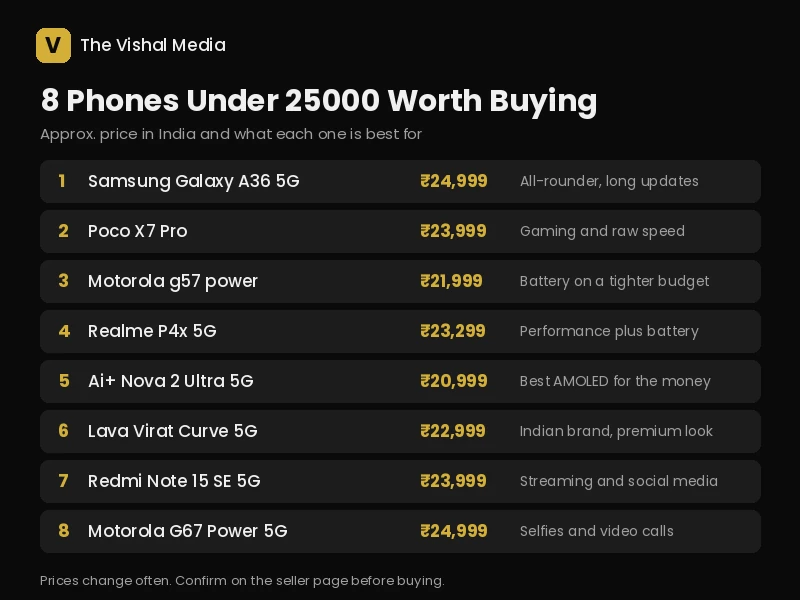
| Phone | Price in India (approx.) | Chip | Display | Battery | Best for |
|---|---|---|---|---|---|
| Samsung Galaxy A36 5G (8GB + 128GB) | ₹24,999 | Snapdragon 6 Gen 3 | 6.7” Super AMOLED, 120Hz | 5000mAh, 45W | All-rounder with long updates |
| Poco X7 Pro (8GB + 256GB) | ₹23,999 | Dimensity 8400 Ultra | 6.67” 1.5K AMOLED, 120Hz | 6550mAh, 90W | Gaming and raw speed |
| Motorola g57 power (8GB + 128GB) | ₹21,999 | Snapdragon 6s Gen 4 | 6.72” FHD+, 120Hz | 7000mAh | Battery life on a tighter budget |
| Realme P4x 5G (6GB + 128GB) | ₹23,299 | Dimensity 7400 Ultra | 6.72” FHD+ LCD, 144Hz | 7000mAh, 45W | Smooth performance plus big battery |
| Ai+ Nova 2 Ultra 5G (6GB + 128GB) | ₹20,999 | Dimensity 7400 | 6.78” AMOLED, 120Hz | 6000mAh, 33W | Best AMOLED screen for the money |
| Lava Virat Curve 5G (6GB + 128GB) | ₹22,999 | Dimensity 7100 | 6.67” FHD+ curved AMOLED, 120Hz | 6000mAh, 45W | Indian brand with a premium look |
| Redmi Note 15 SE 5G (6GB + 128GB) | ₹23,999 | Snapdragon 6 Gen 3 | 6.77” FHD+ AMOLED, 120Hz | 5800mAh, 45W | Streaming and social media |
| Motorola G67 Power 5G (8GB + 128GB) | ₹24,999 | Snapdragon 7s Gen 2 | 6.7” FHD+ LCD, 120Hz | 7000mAh, 30W | Selfies and video calls |
Prices move almost daily in this market. Treat the numbers above as a guide and confirm on the seller page before you order.
Pick-by-Pick: Who Each Phone Really Suits
Each of these phones under 25000 wins on something different, so jump to the use case that matters most to you.
Samsung Galaxy A36 5G: the safest long-term buy
The Galaxy A36 is the phone to pick if you plan to keep it for four years or more, and it is also the most dependable camera phone under 25000 on this list. Samsung promises six major Android updates and six years of security updates, which no other phone on this list matches. It also has an IP67 rating, a 50MP main camera with OIS and a Super AMOLED screen.
Trade-off: 5000mAh is the smallest battery here. Samsung’s Galaxy A17 is sold without a charger at Reliance Digital, so check the A36’s box contents before you pay.
Skip it if: you play heavy games for hours. The Poco X7 Pro is much faster.
Poco X7 Pro: the fastest phone in this budget
If you want a gaming phone under 25000, start here. The Dimensity 8400 Ultra is a class above every other chip on this list, and the phone pairs it with UFS 4.0 storage, which makes apps and games load noticeably quicker. You also get a sharp 1.5K AMOLED screen and 90W fast charging for its 6550mAh battery.
Trade-off: It is an older model, and the listing does not state an update policy. Expect fewer years of Android upgrades than the Samsung.
Skip it if: software support matters more to you than speed.
Motorola g57 power: the battery pick that stays sensible
At around ₹21,999, the g57 power gives you a 7000mAh battery, 8GB RAM and a Snapdragon 6s Gen 4. That is a balanced combination at a time when many phones near this price come with 4GB RAM or HD+ screens. It has over 62,000 ratings on Flipkart, so it is a widely used, known quantity. If you want the best battery phone under 25000 for all-day battery backup without paying for a gaming chip, this is it.
Trade-off: Be honest with yourself about the price. Beebom’s listing showed it at around ₹14,000 earlier this year, and Motorola promises only one year of OS updates. The display is LCD, not AMOLED, and the 8MP selfie camera is basic.
Skip it if: you take a lot of selfies or watch a lot of HDR video.
Realme P4x 5G: performance and battery in one box
The Dimensity 7400 Ultra, UFS 3.1 storage and a 144Hz screen make this one of the smoothest phones at its price, and the 7000mAh battery gives you plenty of headroom for a long day.
Trade-off: This is the phone from the price-hike example earlier, and its price varies a lot between sellers. At around ₹23,299 it is still fair value. At ₹26,999, it is not.
Skip it if: the only listing you can find is above ₹25,000.
Ai+ Nova 2 Ultra 5G: the best screen for the least money
At around ₹20,999, this is the cheapest phone on the list and the strongest AMOLED phone under 25000 and the clearest value for money pick, with an AMOLED display, a Dimensity 7400 chip and an ultra-wide camera. Storage expands up to 1TB, which helps if you shoot a lot of video.
Trade-off: Beebom’s listing notes it is eligible for only one major OS update, so plan to replace it sooner.
Skip it if: you want a phone that stays updated for years.
Lava Virat Curve 5G: an Indian brand that does not feel budget
Lava’s curved AMOLED display gives this phone a premium look, and the Dimensity 7100 with LPDDR5 RAM handles daily multitasking well. It is also an easy choice if you prefer to back an Indian brand.
Trade-off: The single 50MP rear camera means no ultra-wide lens.
Skip it if: you like taking group photos or landscape shots.
Redmi Note 15 SE 5G: built for scrolling and streaming
A 6.77-inch AMOLED screen, a Snapdragon 6 Gen 3 and a 5800mAh battery make this a comfortable phone for YouTube, Instagram and OTT apps. The 20MP front camera is a step above the 8MP sensors on cheaper models.
Trade-off: The second rear camera is a 2MP depth sensor, which adds little to your photos.
Skip it if: camera variety is your priority.
Motorola G67 Power 5G: for people who live on video calls
The 32MP selfie camera, 8GB RAM and a 7000mAh battery suit students in online classes and anyone who takes calls all day. The Snapdragon 7s Gen 2 keeps things smooth.
Trade-off: Beebom lists limited software support as a drawback, and 30W charging is slow for a battery this size.
Skip it if: you want fast charging or long-term updates.
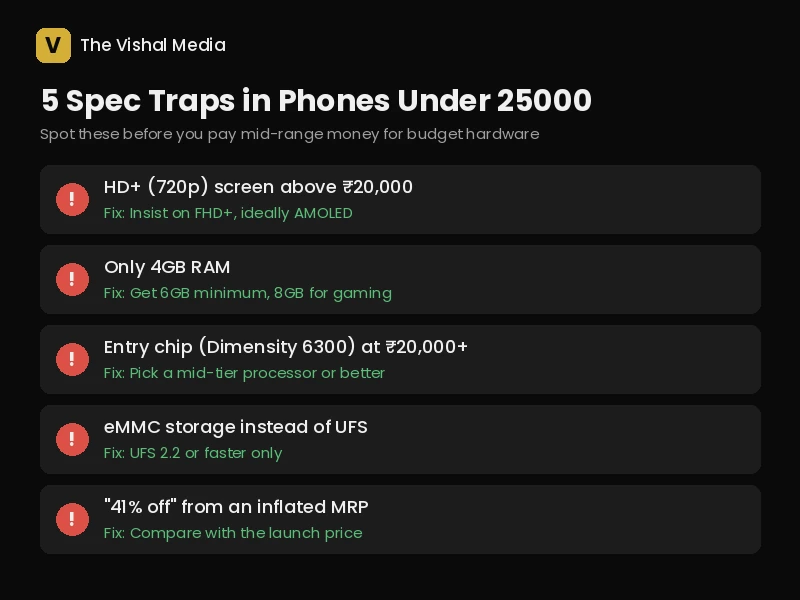
5 Spec Traps That Make a Phone Overpriced
Many phones that used to sell for ₹12,000 to ₹15,000 now sit in the ₹20,000 to ₹25,000 band, which is why so many listings for phones under 25000 are padded with budget hardware. Here is how to spot them.
-
HD+ (720p) display above ₹20,000. The Vivo Y21 5G sells for around ₹23,999 with an HD+ screen. At this price, insist on FHD+ (1080p) at minimum, and preferably AMOLED with a 120Hz refresh rate.
-
4GB RAM. The OnePlus N6 is priced around ₹22,449 with 4GB RAM. Four gigabytes will struggle with modern apps and camera processing within a year or two. Look for 6GB at the very least, and 8GB if you game.
-
An entry-level chip at a mid-range price. The vivo T5 Lite is listed on Flipkart at ₹22,499 with a Dimensity 6300, the same chip that powered ₹12,000-class phones until recently. It runs basic apps fine but slows down in games and heavy multitasking.
-
eMMC storage instead of UFS. The Realme Narzo 90X lists 128GB of eMMC 5.1 storage at around ₹21,499. eMMC is an older, slower storage type, so apps open slower and large files take longer to save.
-
A fake “big discount” from an inflated MRP. The same vivo T5 Lite shows an MRP of ₹38,499 and a “41% off” badge. That MRP was never a real selling price. Compare the price you pay with the phone’s launch price and with other phones on this list, not with the MRP.
If a phone hits even two of these traps, you are almost always better off with one of the eight picks above. Extras like an IP rating are a bonus at this price, not a must, so do not let one feature hide a weak chip or screen.
How to Work Out the Real Price Before You Pay
The price on the product card is rarely what you actually spend on phones under 25000, and the discount badge is often the most misleading part. Here is a worked example using the Poco X7 Pro, which Flipkart lists at ₹23,999 against an MRP of ₹31,999. The offer amounts below are illustrative, so plug in the numbers from your own checkout page.
| Step | Amount |
|---|---|
| MRP shown on the listing | ₹31,999 (ignore this) |
| Listed price (“25% off” badge) | ₹23,999 |
| Bank offer on your card (example) | − ₹1,500 |
| Exchange value quoted at checkout (example) | − ₹4,000 |
| Exchange value cut after the doorstep check (example) | + ₹1,000 |
| No-cost EMI processing fee (example) | + ₹199 |
| Real cost | ₹19,698 |
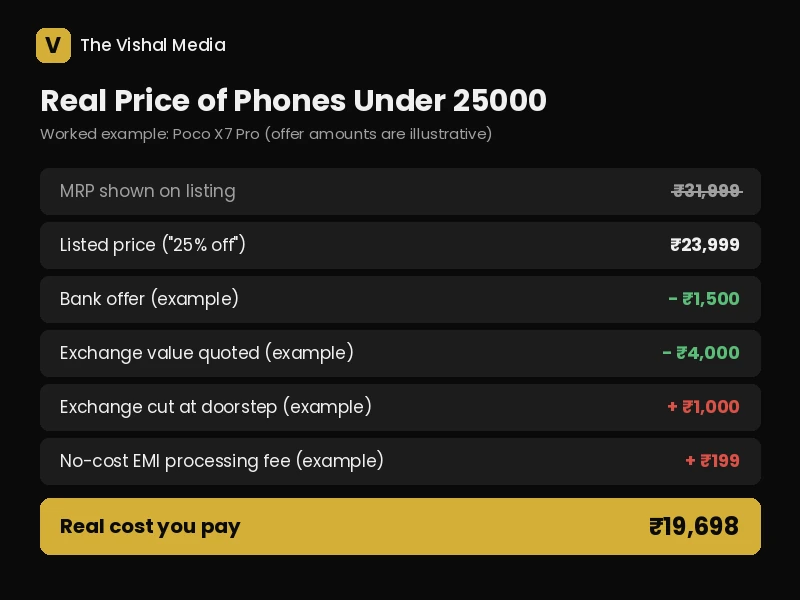
The number to compare is ₹19,698 against what other phones on this list really cost you, not ₹31,999 against ₹23,999. That “25% off” tells you nothing, because the MRP is not a price anyone actually pays.
Three habits make this maths more accurate:
-
Treat the exchange quote as a ceiling. The pickup agent checks your old phone at your doorstep, and any scratch, dent or battery issue can lower the value you were promised.
-
Read the EMI fine print. “No-cost” EMI usually still carries a processing fee, and GST is charged on that fee.
-
Check the price history. The Vishal Media team notes a phone’s lowest price over the last few weeks on a price-history site before buying, because sale prices in this market often match normal-day prices.
Analysts quoted by Digit say festive offers this year lean on financing, cashback and exchange bonuses rather than true price cuts. For the full cost of owning a phone after checkout, including accessories and resale, see our guide to the real cost of a smartphone.
RAM, Storage and Chip Names Explained Simply
Spec sheets throw a lot of letters at you. These four points explain what they mean in everyday use, written from a software developer’s experience of how apps actually use a phone’s hardware, in the same spirit as our guide to making tech simple.
RAM type (LPDDR4X vs LPDDR5 vs LPDDR5X). RAM is your phone’s short-term memory. LPDDR5 and LPDDR5X move data faster and use less power than LPDDR4X, which helps when you switch between many apps, use split-screen multitasking or edit video. At this price, LPDDR4X is acceptable, and LPDDR5 is a bonus (the Lava Virat Curve has it).
Storage type (eMMC vs UFS 2.2 vs UFS 3.1 vs UFS 4.0). This decides how fast apps open, how quickly photos save and how long installs take. eMMC is the slowest and should be avoided. UFS 2.2 is fine for most people. UFS 3.1 (Realme P4x) and UFS 4.0 (Poco X7 Pro) feel snappier, especially when you shoot burst photos or 4K video.
Processor (chip) tiers in this budget, from basic to strongest:
-
Entry: Dimensity 6300, Snapdragon 4 Gen 4. Good for calls, WhatsApp and YouTube. Not ideal above ₹18,000.
-
Mid: Dimensity 7100, Dimensity 7400, Snapdragon 6s Gen 4, Snapdragon 6 Gen 3, Snapdragon 7s Gen 2. Smooth daily use and casual gaming.
-
Top of this budget: Dimensity 8400 Ultra. Comfortable with demanding games at higher settings.
AI features. Most phones here now advertise AI photo editing or AI assistants. Many of those features run in the cloud, but a growing number run directly on the phone’s chip, which is faster and more private. Our explainer on what Edge AI is and how it works on phones covers the difference, and it is worth knowing before you pay extra for an “AI phone” label.
Frequently Asked Questions
Which is the best phone under 25000 right now?
Among phones under 25000, the Samsung Galaxy A36 5G is the best overall pick for most people because it combines a Super AMOLED screen, an OIS camera, IP67 protection and six years of updates. If gaming matters most, choose the Poco X7 Pro instead.
Should I pick a 4G phone to save money in this budget?
No. Brands are bringing 4G models back mainly to hold prices below ₹15,000, as memory costs climb. At ₹20,000 and above, every phone on our list is a 5G phone under 25000, so dropping to 4G saves you little and leaves you behind as 5G coverage keeps expanding.
Which phone under 25000 has the best battery backup?
Three picks carry 7000mAh batteries: the Motorola g57 power (cheapest), the Realme P4x (adds a faster chip and 45W charging) and the Motorola G67 Power (adds a 32MP selfie camera). If quick refills matter more than size, the Poco X7 Pro’s 6550mAh battery with 90W charging tops up far faster.
Which phone under 25000 has the best camera?
For the main camera, the Samsung Galaxy A36 and Poco X7 Pro both use 50MP sensors with OIS, which improves low-light camera quality and keeps video steady. For selfies, the Motorola G67 Power’s 32MP front camera stands out.
Is UFS 2.2 storage good enough in a phone under 25000?
For WhatsApp, Instagram, YouTube and everyday photos, yes. You will notice the gap mainly when installing large games, shooting long 4K clips or saving burst shots. If those matter to you, the Realme P4x (UFS 3.1) and Poco X7 Pro (UFS 4.0) are the two picks here with faster storage. The one type to walk away from is eMMC.
Are refurbished phones a better buy than new phones in this budget?
A refurbished phone can be, if you buy certified refurbished stock with a warranty from a known seller. A refurbished phone from a higher segment can beat a new budget phone on camera and build. Check the battery health, warranty length and return policy before paying.
Should You Buy Now, Wait, or Look Elsewhere?
Here is the plain verdict for each type of buyer.
-
Your phone is dying and you need one this week: buy the Galaxy A36 if you want years of updates, or the Motorola g57 power if you want to spend less and get a huge battery.
-
You game daily: the Poco X7 Pro is the only phone under ₹25,000 here with an upper-tier chip and UFS 4.0.
-
Your current phone still works: hold on. Digit reports that memory contract prices are not expected to normalise before late 2027, so prices are unlikely to fall soon. Waiting will not save money, but it is not a reason to rush either.
-
You want flagship-level build or cameras: consider a certified refurbished phone from a higher segment, or see our best smartphone in India for every budget guide if you can stretch beyond ₹25,000.
-
You prefer an Indian brand: the Lava Virat Curve 5G gives you an AMOLED screen and LPDDR5 RAM without the usual budget feel.
Whichever of these phones under 25000 you choose, run it past the five traps once before checkout. That single check saves more money than any sale banner.
Send Us Three Details, Get One Clear Pick
Message The Vishal Media with three things: your exact budget, the phone you use now, and the one thing that annoys you most about it (battery, camera, lag or screen). We will reply with the phone from this list that fixes that problem, along with the real price you should expect to pay.
Disclaimer
Phone prices and offers in India are changing frequently right now. The prices in this article were checked on Flipkart and other listing sites at the time of writing and may have moved since. This article is not sponsored by any brand, and no phone was ranked for payment. You can read how we pick and review products in our editorial policy. Always confirm the price, variant and box contents on the seller’s page before you place an order.