

A barista in Chicago gets a text asking whether she really just spent $900 at an electronics store in another state. A college student in Austin turns a 40-page reading assignment into a one-page study guide before class. A dad in Columbus points his phone at his daughter’s algebra homework and sees each step explained. None of them typed the words artificial intelligence, yet all three used it before lunch.
This guide from The Vishal Media explains AI the way it actually shows up in everyday American life: no jargon walls, just what it is, how it learns, how the US is handling it, and how you can start using it well today. Each section goes one layer deeper, so you can stop wherever your question is answered.
What Is Artificial Intelligence? The One-Minute Version
Artificial intelligence is the ability of a computer system to learn patterns from data and use them to make decisions, predictions or new content, instead of following only fixed, hand-written rules. Computer scientist John McCarthy, who helped name the field, described it as “the science and engineering of making intelligent machines” (Stanford).
The difference between normal software and AI is easiest to see side by side. A calculator follows exact rules: 2 + 2 is always 4, and it never learns anything new. A spam filter works differently. Nobody writes a rule for every possible scam email. Instead, the filter studies millions of examples of spam and genuine mail, notices patterns, and then judges emails it has never seen before.
Think of how a toddler learns to recognize a dog. Nobody hands them a rulebook about tails and floppy ears. They see enough dogs, and the pattern clicks. AI learns in a similar spirit, only from far more examples and with math instead of curiosity.
One thing AI does not do is think or feel the way people do. It predicts the most likely answer based on patterns. That’s why it can sound confident and still be wrong, which we’ll come back to.
Artificial Intelligence Examples You Already Use
Most artificial intelligence examples are quiet. This is what AI in daily life really looks like: models working in the background of apps you open every day.
-
Credit card fraud alerts: card networks and banks use AI to spot purchases that don’t fit your normal pattern, like a large charge in a city you’ve never visited.
-
Google Maps and Waze: traffic predictions and arrival times come from AI analyzing live movement data from millions of phones.
-
Netflix, Spotify and TikTok: recommendation systems learn what you watch, skip and replay, then decide what to show next.
-
Siri, Alexa and Google Assistant: speech recognition turns your voice into commands, from setting timers to adding items to a shopping list.
-
Google Lens: point your camera at a plant, a restaurant menu in Spanish or a math problem, and AI recognizes, translates or explains it.
-
Spam call labels: carriers and phone makers use pattern analysis to flag “Scam Likely” calls before you answer.
-
Face ID and camera features: face unlock, portrait mode and night photos often run directly on your phone’s chip. That version is called AI that runs on your phone, or edge AI.
-
Chatbots: ChatGPT, Gemini, Claude and Microsoft Copilot answer questions, draft emails and summarize documents in plain language.
How Does Artificial Intelligence Work?
To see how artificial intelligence works, picture teaching a computer to tell a Honeycrisp apple from a Granny Smith.
Step 1: Collect data. You gather thousands of apple photos, each labeled with its variety. The quality of this data decides the quality of the AI.
Step 2: Train the model. The computer studies the photos and adjusts millions of internal settings until it reliably links features, such as color, shape and skin texture, to the right label. This stage needs heavy computing power.
Step 3: Test it. You show it photos it has never seen. If it gets most of them right, it has learned a real pattern rather than memorizing the training set.
Step 4: Use it. Now a grocery app can scan an apple at self-checkout and identify it instantly. Using a trained model on new input is called inference.
Step 5: Improve it. When the model makes mistakes, those cases become new training data, and the next version gets better.
Every AI system you’ve used follows this broad cycle, whether it’s recognizing faces, predicting traffic or writing an email. The difference is the type of data and the size of the model.
Types of Artificial Intelligence
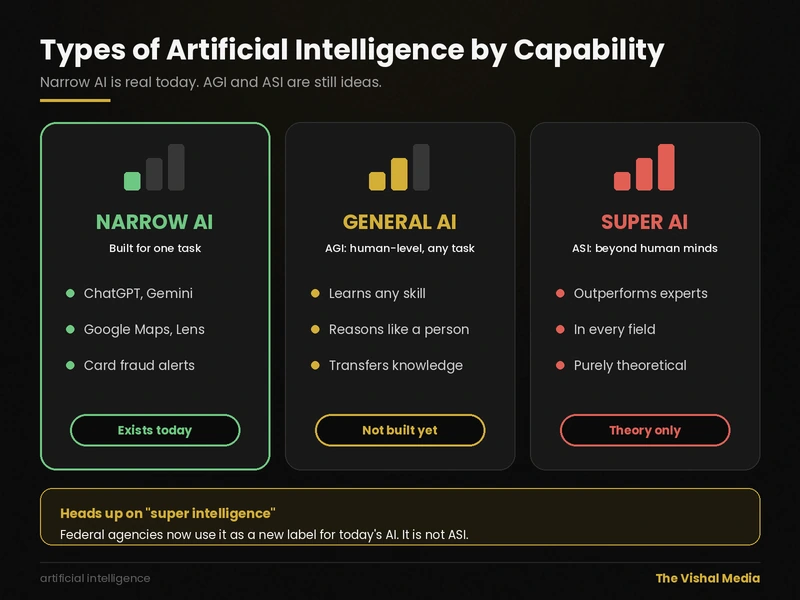
The types of artificial intelligence get confusing because people sort AI in two different ways: by how capable it is, and by the technology behind it.
By capability
| Type | What it means | Exists today? |
|---|---|---|
| Narrow AI | Built for one task or a small set of tasks | Yes. Every AI you use, from Maps to ChatGPT |
| Artificial general intelligence (AGI) | Human-level ability to learn and reason across almost any task | No. Experts disagree sharply on if and when it will arrive |
| Artificial superintelligence (ASI) | Intelligence beyond the best human minds in every field | No. A theoretical idea discussed in research and policy |
By technology
These sit inside each other, like a set of nested boxes.
-
Machine learning: the broad method of learning from data instead of fixed rules. Credit scoring and fraud detection use it.
-
Deep learning: machine learning that uses neural networks with many layers. It powers computer vision, such as Face ID, and natural language processing (NLP), such as voice assistants and live captions.
-
Generative AI: deep learning models that create new text, images, audio or video. ChatGPT, Gemini and image generators belong here. Many run on large language models (LLMs), which are trained on huge amounts of text to predict and generate language.
-
AI agents: systems that plan and take a series of actions toward a goal, such as comparing flights, checking your calendar and drafting a booking, with a human approving key steps.
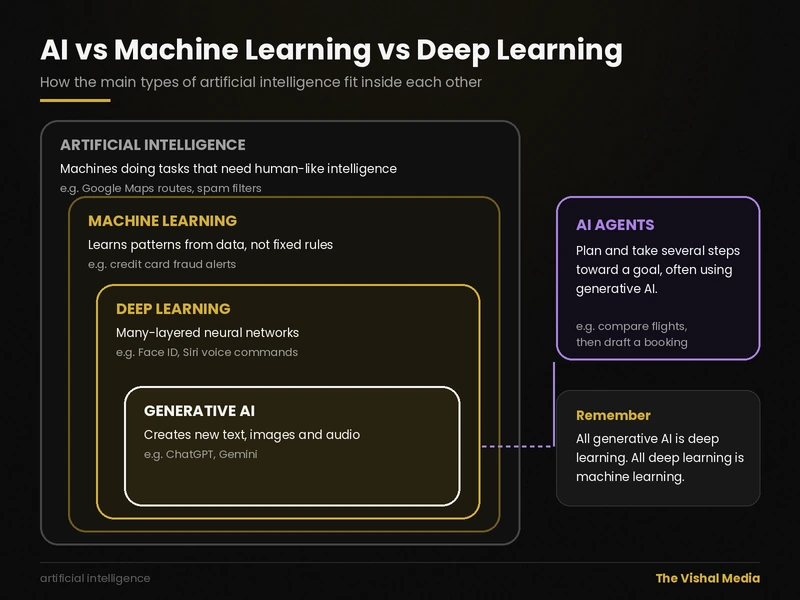
So all generative AI is deep learning, all deep learning is machine learning, and all of it falls under artificial intelligence.
“Super Intelligence” vs Superintelligence: Why Washington’s New Term Is Confusing
If you’ve seen NASA’s website describe “super intelligence” where you expected “artificial intelligence”, there’s a simple reason. A recent executive order directs federal agencies to use the term “Super Intelligence”, or “SI”, for the technologies that were previously called AI. NASA updated its explainer page to match, and you’ll likely see the new wording on other federal websites too.
Three points keep this from becoming confusing:
-
It’s a label, not a breakthrough. The order points to the existing federal legal definition of AI. Nothing about the technology itself changed overnight.
-
It’s not the same as superintelligence. The order’s “super intelligence” covers today’s ordinary AI systems. Artificial superintelligence (ASI) still means a hypothetical AI smarter than humans, which doesn’t exist.
-
The legal definition hasn’t changed yet. The order asks for proposed legislation, and the current statutory definition stays in place until Congress or later executive action replaces it. Companies, schools and most media still say “artificial intelligence”.
So when a headline says “super intelligence”, check the context before assuming machines just outsmarted humanity.
Artificial Intelligence in the US: Who Sets the Rules?
Artificial intelligence in the US is growing faster than the rules around it, and the policy picture is still taking shape.
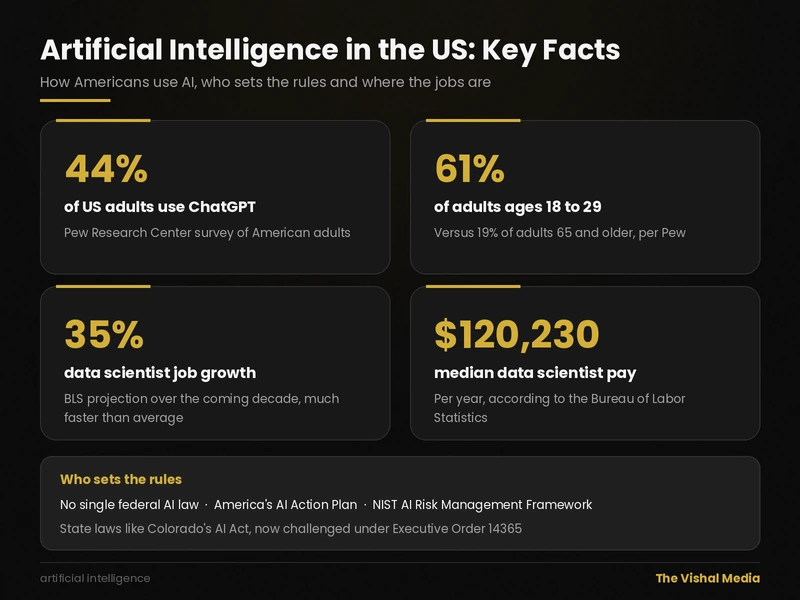
No single federal AI law. Unlike the European Union’s AI Act, the United States doesn’t have one comprehensive AI statute. Instead, existing laws on consumer protection, discrimination, privacy and copyright apply to AI, alongside voluntary frameworks like NIST’s AI Risk Management Framework, which many organizations use to build responsible AI.
A federal push for speed. The White House’s “Winning the Race: America’s AI Action Plan” is built on three pillars: accelerating AI innovation, building American AI infrastructure such as data centers and energy, and leading in international AI diplomacy and security (Steptoe).
A tug-of-war with the states. States like Colorado have passed their own AI laws, including rules on algorithmic discrimination. Executive Order 14365 created a Justice Department AI Litigation Task Force to challenge state AI laws that conflict with federal policy and called for a national framework. The order itself doesn’t overturn any state law, so businesses still have to watch both levels (Taft).
Americans are using AI, but cautiously. Pew Research Center found that 44% of US adults say they use ChatGPT, including 61% of adults ages 18 to 29 and 19% of those 65 and older (Pew Research Center). Use is rising fast, yet surveys keep showing that many Americans want more oversight of how AI is built and deployed.
How to Use AI Tools Today (With Real Prompts)
The fastest way to understand AI is to use it for something you actually need. Here are three everyday cases.
For a student: instead of asking “explain photosynthesis”, try:
“Explain photosynthesis to a 10th-grade biology student using a backyard garden example, then give me three quiz questions to check my understanding.”
For a job seeker: paste a job description (not your personal details) and ask:
“Here is a job posting for an entry-level marketing coordinator. List the five skills it values most and suggest how I can show each one on my resume.”
For a small business owner:
“Write a friendly, 50-word Instagram caption announcing a 20% Black Friday discount at my bakery in Denver. Keep it warm, not salesy.”
Notice the pattern in all three. A good prompt usually has four parts: role or audience (10th-grade student), task (explain), context (backyard garden, Denver bakery) and format (three quiz questions, 50 words). A vague prompt gets a vague answer. A specific one gets something you can use.
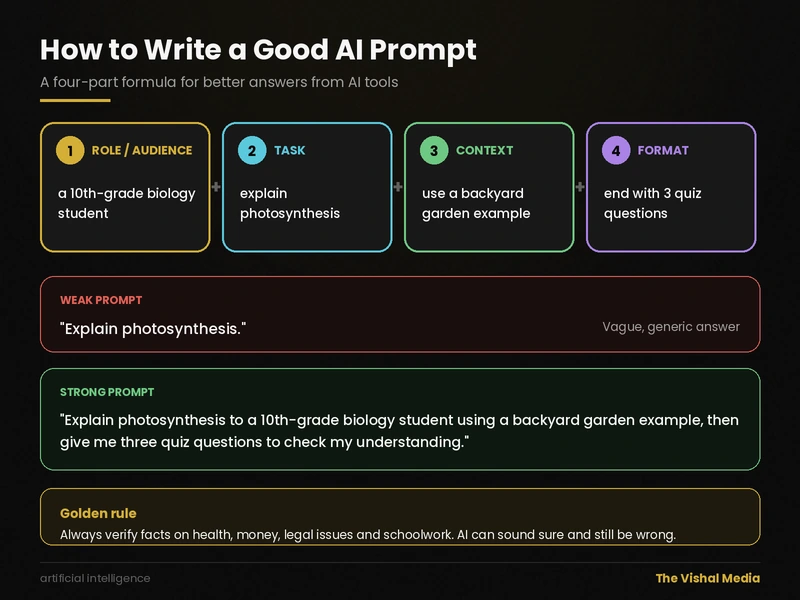
One rule never changes: check important facts yourself, especially anything about health, money, legal issues or schoolwork you’ll submit.
What AI Gets Wrong: Limits You Should Know
AI is powerful, but it has blind spots that every user should understand.
-
Hallucinations: AI can invent facts, quotes, book titles and even court cases, then present them confidently. Several US lawyers have been sanctioned for filing briefs that cited cases a chatbot made up.
-
AI bias: if training data under-represents certain groups, accents or dialects, the AI performs worse for them. Speech tools may stumble on strong regional accents or non-native English speakers.
-
Privacy risks: whatever you type into a chatbot may be stored or reviewed. Never paste your Social Security number, bank details, medical records, passwords or confidential work files.
-
Outdated knowledge: many models learn from data up to a certain point and may not know recent events unless they’re connected to live search.
-
Heavy energy use: training and running large models consumes a lot of electricity and hardware, which raises cost and environmental questions. Running smaller models on devices is one way around this, as our comparison of edge AI vs cloud AI explains.
These issues sit at the core of AI ethics: fairness, transparency, privacy and accountability. Used with these limits in mind, AI becomes a sharp assistant rather than an unreliable oracle.
AI Scams and Deepfakes: How to Stay Safe
The same technology that writes your Instagram caption can clone a voice. The Federal Trade Commission has warned that a scammer may need only a short audio clip of a family member’s voice, often pulled from social media, to fake a panicked call (FOX 5 New York).
The script usually sounds like a grandchild or relative in trouble: a car accident, an arrest, a hospital bill, and a request to send money right now. Deepfake videos follow a similar playbook, showing a celebrity or CEO “endorsing” a crypto platform or investment scheme.
Protect yourself and your family:
-
Agree on a family safe word that a real caller would know and a scammer wouldn’t.
-
Hang up and call back on a number you already have saved, not the one that called you.
-
Treat urgency as a warning, especially when paired with wire transfers, gift cards, Zelle or cryptocurrency.
-
Look closely at videos: lip movements that don’t match the words, unnatural blinking, odd lighting on the face or a flat-sounding voice.
-
Report it: file a report at ReportFraud.ftc.gov, and if money was lost online, also report to the FBI’s Internet Crime Complaint Center at ic3.gov. Contact your bank immediately to try to stop the payment.
Will AI Take Your Job? Myths vs Facts
Fear and hype both travel fast. Here’s a calmer view of the most common claims.
Myth: AI will take all jobs. Fact: AI automates specific tasks, not whole people. Data entry, basic customer replies and first drafts are already changing. At the same time, workers who use AI well, from analysts and developers to marketers and teachers, are getting more done. The bigger risk is not learning the tools at all.
Myth: AI is only for tech companies. Fact: dental offices use AI scheduling, farmers use AI crop monitoring, and small shops use it to write product descriptions. Most AI tools now need no coding.
Myth: AI thinks and has feelings. Fact: AI produces patterns that can feel human, but it has no awareness, intentions or emotions.
Myth: if AI said it, it must be true. Fact: AI can be confidently wrong. Verification is your job, not the chatbot’s.
How to Start Learning AI: A Practical Roadmap
Whether you want to use AI smartly or build it, there’s a path for you. This is the sequence we’d recommend at The Vishal Media.
If you’re not from a technical background:
-
Use one AI chatbot daily for real tasks for two weeks: emails, summaries, meal plans, trip planning.
-
Build basic AI literacy with a free introductory course such as Elements of AI, created by the University of Helsinki, which explains AI concepts without requiring any math or coding.
-
Practice prompt writing using the four-part formula above, and get in the habit of fact-checking outputs.
If you want to build AI:
-
Learn Python basics and how to work with data using tools like pandas.
-
Brush up on high school statistics and introductory linear algebra; you need the concepts, not advanced proofs.
-
Study machine learning with small projects, such as predicting home prices or classifying product reviews.
-
Move to deep learning and generative AI, including how to build apps on top of existing models.
-
Publish your projects on GitHub. In interviews, a working project often says more than a certificate.
AI career options in the US include data analyst, machine learning engineer, AI product manager, AI content specialist and edge AI engineer, who builds AI that runs on phones, cameras and devices. Demand is strong: the Bureau of Labor Statistics projects data scientist jobs to grow 35% over the coming decade, much faster than average, with a median pay of $120,230 a year (BLS).
Frequently Asked Questions
What is artificial intelligence in simple words?
It’s a computer’s ability to learn from examples and then make decisions or create content on its own. Your phone recognizing your face or Netflix suggesting your next show are everyday versions of it.
Is ChatGPT artificial intelligence?
Yes. ChatGPT is a generative AI tool built on a large language model. It’s still narrow AI, because it’s designed for language tasks and doesn’t have general, human-like understanding.
What are the 4 types of artificial intelligence?
A popular classification groups AI by how it handles memory and understanding: reactive machines, which respond only to the present (like early chess computers); limited memory AI, which learns from past data (like most modern AI); theory of mind AI, which would understand emotions and intentions; and self-aware AI. Only the first two exist today.
What is the difference between AI and machine learning?
AI is the overall goal of making machines act intelligently. Machine learning is one method of getting there, by training systems on data instead of programming every rule by hand.
Is AI regulated in the United States?
Partly. There’s no single federal AI law, but existing consumer protection, privacy and anti-discrimination laws apply, several states have passed AI-specific rules, and federal agencies follow executive orders and voluntary frameworks like the NIST AI Risk Management Framework.
Is artificial intelligence dangerous?
AI itself is a tool, but it can cause harm through misuse, such as deepfake scams, or through mistakes and bias. Using trusted tools, protecting personal data and verifying important information keep most risks in check.
What is the best AI course for beginners?
Start with a free, no-code introduction like Elements of AI to learn the concepts. After that, pick a course with hands-on projects that match your goal, whether that’s using AI tools at work or building models.
Can I learn AI without coding?
Yes, for using AI tools well, writing prompts and understanding the concepts. To build or customize AI models, you’ll need to learn programming, usually Python.
Keep Exploring AI With The Vishal Media
Artificial intelligence is moving fast, but the basics in this guide will stay useful while the tools keep changing. Here’s where to go next:
-
Find out where AI actually runs. Read our guide to what is edge AI, then compare approaches in edge AI vs cloud AI.
-
Save this page. Use the Save button so it’s handy when someone in your family asks what AI really is, or forwards a “too good to be true” AI investment video.
-
Have a question or a tool you want explained? Send us a topic and The Vishal Media may cover it next.
-
Keep learning through our technology guides and the full The Vishal Media blog.
Disclaimer
This article is for educational purposes only. AI tools, laws and government policies change quickly, so please verify current details from official sources. Do not treat AI-generated answers as medical, financial or legal advice; consult a qualified professional for those decisions.