
₹7,200 a year. That’s roughly what you pay for each year of software support on a ₹50,380 Google Pixel 10a, and on a ₹42,999 OnePlus Nord 6. The ₹37,990 Motorola Edge 70 Pro is the cheapest of the three, yet it works out costlier at about ₹7,600 a year, because it’s promised fewer years of updates. Most “best smartphone” lists skip this maths, and it’s the quickest way to find out whether a phone is actually good value or just cheap today.
This guide doesn’t rank phones by hype or launch buzz. It ranks them the way an Indian buyer actually lives with a phone: years of updates, 5G on Jio, Airtel and Vi, 45°C summers, monsoon rain and the total amount that leaves your bank account.
Price ÷ Update Years: The Number Most “Best Phone” Lists Ignore
A phone that stops getting software updates and security patches becomes riskier to use for banking and UPI, and it loses new features and resale value. That’s why the number of years of updates matters as much as the processor.
To compare phones fairly, The Vishal Media divided each one’s price by the years of support its maker promises:
Price ÷ years of security updates = cost per year of support
| Phone | Approx. price | Update promise | Cost per year of support |
|---|---|---|---|
| POCO M8x 5G | ₹18,600 | 4 OS upgrades, 6 years security | ~₹3,100 |
| Samsung Galaxy A17 5G | ₹22,500 | 6 OS upgrades, 6 years security | ~₹3,750 |
| Motorola Edge 70 Pro | ₹37,990 | 3 OS upgrades, 5 years security | ~₹7,600 |
| OnePlus Nord 6 | ₹42,999 | 4 OS upgrades, 6 years security | ~₹7,200 |
| Google Pixel 10a | ₹50,380 | 7 years OS and security | ~₹7,200 |
| Samsung Galaxy S26 FE | ₹72,999 | 7 years OS and security | ~₹10,400 |
| iPhone 17 (256GB) | ₹88,999 | At least 5 years security (Apple’s minimum) | ~₹17,800 or less |
| Samsung Galaxy S26 Ultra | ₹1,24,999 | 7 years OS and security | ~₹17,900 |
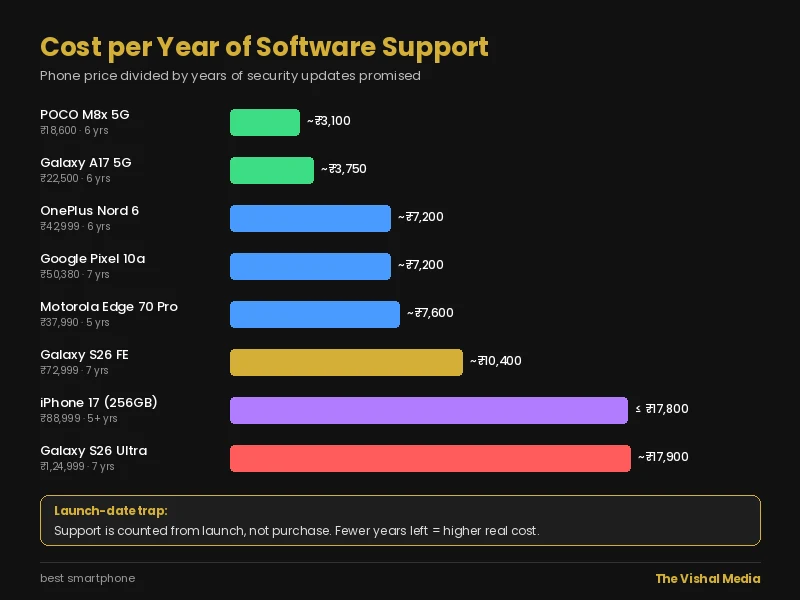
Prices are approximate lowest prices for the base variant on major Indian online stores and change often, sometimes daily. Update promises are from each brand’s published software update policy.
Worked example: the launch-date trap. Update windows are counted from the day a phone launches, not the day you buy it. The Galaxy A17 5G has been on sale for over a year, so about five of its six years are left. That makes the real figure ₹22,500 ÷ 5, or around ₹4,500 a year, not ₹3,750. A newer phone at the same price can beat an older one on this measure alone, so always check the launch date before you pay.
Where iPhones fit: Apple doesn’t publish a fixed number of iOS upgrades. Its filing under the UK’s product security rules commits to security updates for a minimum of five years, and older iPhones have often kept getting major iOS upgrades for six years or more. Treat the ₹17,800 figure as the worst case, not the likely one.
One honest limit: few people keep a phone for seven years, and batteries wear out sooner than software support ends. Use this number to compare phones, not as a promise of how long yours will last.
The Best Smartphone for Every Budget in India
Phone prices in India are moving in two directions at once. Several brands have raised official prices: the Pixel 10a went up by ₹6,000, the iPhone 17 (256GB) jumped from ₹82,900 to ₹99,900, Samsung raised prices of the Galaxy A37 and A57, and Motorola added ₹3,000 to the Edge 70 Fusion. The reasons reported include costlier RAM and storage chips, driven largely by demand from AI data centres, and wider supply chain pressure. At the same time, online stores often sell well below those official prices. The iPhone 17 was listed for about ₹11,000 under its official price when we checked, and the Galaxy S26 Ultra for ₹15,000 under its launch price. So the number in launch news is rarely the number at checkout. Always compare current store prices before deciding.
With that in mind, here’s the best smartphone in each budget, chosen for value per year, real-world strengths and an honest trade-off.
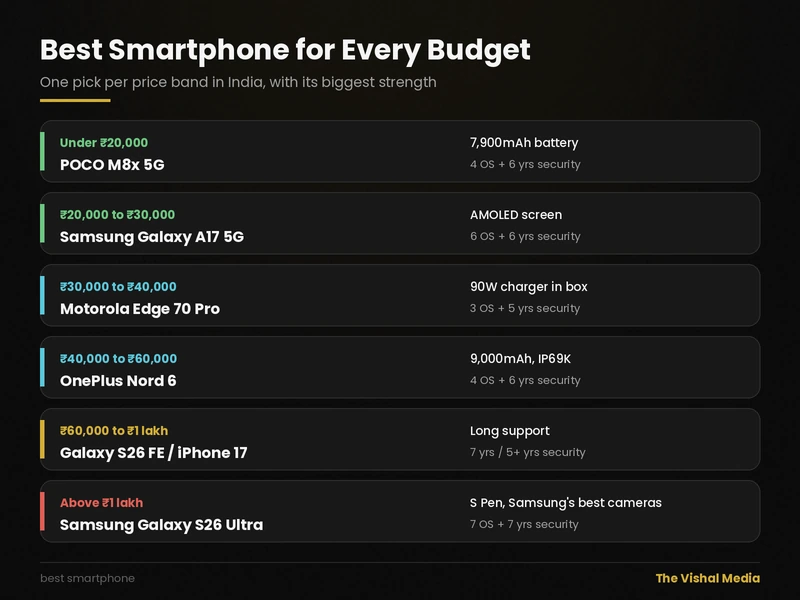
Under ₹20,000: POCO M8x 5G
If you’re hunting for the best phone under 20000, this is the one that balances battery and long support best.
-
Why it wins: a 7,900mAh battery, 45W charging, IP64 dust and splash protection, plus 4 OS upgrades and 6 years of security patches. That’s rare at this price.
-
Who it’s for: students, first-time smartphone users and anyone who wants two days of battery.
-
Trade-off: the screen is an HD+ LCD, not AMOLED, and storage is the slower UFS 2.2 type, so apps open a little slower than on pricier phones.
₹20,000 to ₹30,000: Samsung Galaxy A17 5G
-
Why it wins: 6 OS upgrades and 6 years of security updates, a 6.7-inch Super AMOLED screen and Samsung’s large service network in smaller towns.
-
Who it’s for: parents and anyone who wants one phone for many years without fuss.
-
Trade-off: the Exynos 1330 chip handles daily apps well but isn’t built for heavy gaming, charging tops out at 25W and IP54 means splash resistance only.
₹30,000 to ₹40,000: Motorola Edge 70 Pro
-
Why it wins: a MediaTek Dimensity 8500 chip, 6,500mAh battery and 90W charging with the charger in the box.
-
Who it’s for: people who want flagship-level speed without paying flagship prices.
-
Trade-off: 3 OS upgrades and 5 years of security is the shortest promise among these picks, and 91mobiles counted 47 pre-installed apps on it.
₹40,000 to ₹60,000: OnePlus Nord 6
-
Why it wins: a 9,000mAh battery, Snapdragon 8s Gen 3 chip, 80W charger included and an IP69K rating, with 4 OS upgrades and 6 years of security.
-
Who it’s for: heavy users, gamers and field workers who can’t stop to charge.
-
Update-first alternative: the Google Pixel 10a (around ₹50,000) gets 7 years of updates and clean software, so it matches the Nord 6 on cost per year, but it has a smaller battery and no charger in the box.
₹60,000 to ₹1 lakh: Samsung Galaxy S26 FE or iPhone 17
-
Android pick: the Galaxy S26 FE (around ₹73,000) brings 7 years of OS and security updates and an Exynos 2500 chip at a lot less than the S26 Ultra.
-
iPhone pick: the iPhone 17 (around ₹89,000 for 256GB online, against an official price of ₹99,900) suits anyone already using a Mac, iPad or Apple Watch, and iPhones are widely sold and serviced across India.
-
Trade-off: neither includes a charger, so add ₹1,500 to ₹2,500 if you need one.
Above ₹1 lakh: Samsung Galaxy S26 Ultra
-
Why it wins: a Snapdragon 8 Elite Gen 5 chip, S Pen support, 7 years of updates and the most advanced camera setup in Samsung’s lineup.
-
Camera-first alternative: the Vivo X300 Ultra (₹1,59,999) focuses on photography and gets 5 OS upgrades and 7 years of security.
-
Trade-off: at around ₹17,900 per year of support, you’re paying mainly for premium features, not longer support. Its 256GB model launched at ₹1,39,999 and now sells for about ₹15,000 less online, so check before you pay.
Five Questions That Point You to the Right Phone
Specs alone won’t tell you which smartphone is best for you. These five questions usually will.
1. How many years will you keep it? If you change phones every two years, update length matters less and resale value matters more. If you keep phones for four years or longer, stick to phones with at least 5 years of security updates left.
2. What do you use most: camera, battery or games? Pick one priority and let it decide. A delivery partner on a bike all day needs battery more than a periscope camera. A creator posting reels daily needs a strong main camera and stabilisation. A gamer needs a strong chip that doesn’t overheat.
3. iPhone or Android? If your family already uses iPhones, features like iMessage, FaceTime and AirDrop make life easier. If you want a charger in the box, faster charging and more features for less money, Android gives you far more choice.
4. Who is the phone for? For parents, pick a large screen, a loud speaker and simple software, like the Galaxy A17 5G. Our guide to easy technology shows how to set up any phone so older users feel confident with it. For students, a big battery and long updates matter more than a premium camera.
5. Do you really need a flagship? Most people don’t. If your day is WhatsApp, UPI, YouTube, Instagram and calls, a ₹20,000 to ₹45,000 phone does all of it smoothly. Flagships make sense when you shoot a lot of photos and videos, play demanding games or want the longest support.
Will It Work Well on Jio, Airtel and Vi 5G?
Not every 5G phone works equally well on Indian networks. The best 5G phone for you is one that supports the 5G bands your operator actually uses.
| Operator | Main 5G bands | Network type |
|---|---|---|
| Jio | n78 (3.5 GHz), n28 (700 MHz), n258 (26 GHz mmWave) | Standalone (SA) 5G |
| Airtel | n78 (3.5 GHz), n258 (26 GHz), plus lower bands like n1, n3 and n8 | Mostly non-standalone (NSA), built on its 4G network |
| Vi | n78 (3.5 GHz), n258 (26 GHz) | Still expanding its 5G to more circles |
What this means for you:
-
n78 is a must. It’s the main 5G band for all three operators. Almost every 5G phone sold in India supports it.
-
n28 matters for Jio users. This low band travels farther and works better indoors and in rural areas. Some cheaper phones skip it, so you may get 5G in the city but drop to 4G in your village.
-
SA vs NSA, simply put: standalone 5G runs on its own core network, while non-standalone 5G leans on the 4G network for some tasks. Most recent 5G phones handle both, but some older or cheaper models need a software update for Jio’s SA 5G.
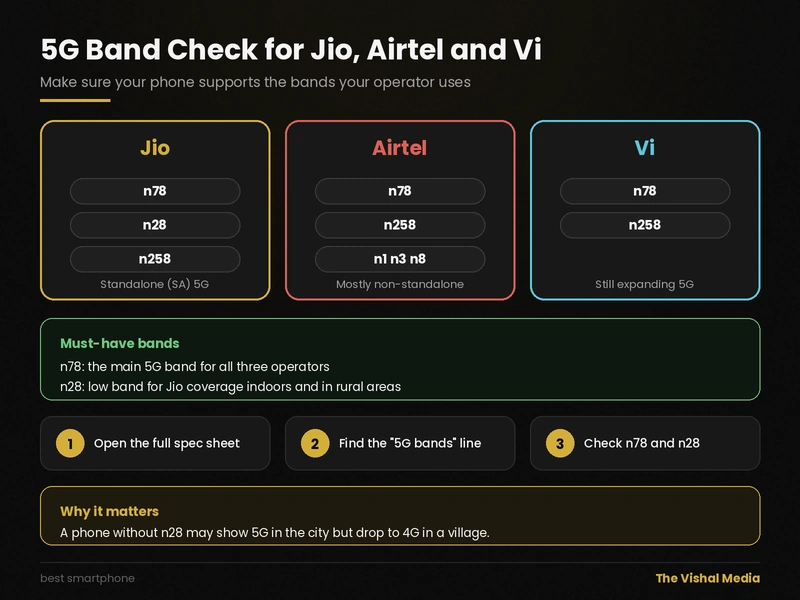
How to check before buying: open the phone’s full specifications on the brand’s website or a spec site like GSMArena and look for the “5G bands” line. If n78 and n28 are both there, you’re covered on all three networks.
Questions Indian Buyers Ask Before Buying a Phone
Which is the best smartphone in India right now?
For most people, the Samsung Galaxy S26 Ultra is the best Android phone overall and the iPhone 17 is the best iPhone. If you want value rather than the top model, the OnePlus Nord 6 offers flagship-level speed and a 9,000mAh battery for around ₹43,000.
Which phone brands give the longest software updates?
Samsung (Galaxy S series and newer A series) and Google Pixel lead with up to 7 years. Vivo’s X300 series offers 7 years of security patches, while OnePlus and many newer Xiaomi and POCO models promise 6 years of security updates. Budget lines often get less, so check the exact model, not just the brand.
Should I buy a phone now or wait for a sale?
If your current phone works, a festive or bank-card sale can bring the effective price down by a few thousand rupees. But official prices of several phones have been going up, while store discounts come and go, so waiting months for a cut on a specific model is a gamble. If you need a phone now, buy it with whatever bank offer or exchange deal is running.
Which is the best smartphone under ₹20,000?
The POCO M8x 5G stands out for its 7,900mAh battery and 6 years of security updates. If you can stretch to around ₹22,500, the Samsung Galaxy A17 5G adds an AMOLED screen and 6 OS upgrades.
Is 8GB RAM enough?
Yes, for nearly everyone. 8GB handles social media, banking apps, video calls and most games comfortably. Go for 12GB only if you play heavy games or keep dozens of apps open. Ignore “virtual RAM” or “extended RAM” claims, since it borrows storage space and is much slower than real RAM.
Do I really need a 5G phone?
If you’re buying a new phone to keep for three or more years, yes. Jio and Airtel already offer 5G in most cities and many towns, and most new phones above ₹15,000 support it, though a few budget models are still 4G-only. Just make sure it supports the n78 and n28 bands.
Built for Indian Conditions: Heat, Monsoon and Dual SIM
A phone reviewed in a cool studio can behave very differently on a 45°C afternoon in Jaipur or a soaked commute in Mumbai.
Heat: when a phone gets too hot, it slows itself down to protect the chip, which is called throttling. Phones with larger vapour chambers and efficient chips hold their speed better. To reduce heating, don’t charge or game with the phone in direct sun or on a car dashboard, and remove thick covers while fast-charging.
Monsoon and dust: the IP rating tells you how much protection you get.
| Rating | What it means in daily life |
|---|---|
| IP54 | Dust-protected and handles splashes, like light rain |
| IP64 | Fully dust-tight and handles splashes |
| IP68 | Dust-tight and survives being submerged, usually up to 1.5 metres for 30 minutes as tested by the maker |
| IP69 / IP69K | Also survives high-pressure, high-temperature water jets |
Water damage often isn’t covered by warranty, even on IP68 phones, so treat the rating as protection against accidents, not permission to swim with your phone.
Dual SIM, eSIM and storage:
-
Almost all Android phones in India take two physical SIMs. iPhones sold in India use one physical SIM plus eSIM, while the iPhone Air is eSIM-only.
-
Few phones above ₹20,000 still have a microSD slot, so choose your storage carefully. 128GB fills up fast with WhatsApp media and 4K videos, and 256GB is the safer choice if you plan to keep the phone for years.
-
Check that the phone supports your Indian language keyboard and voice typing, especially if you’re buying for parents.
The Real Price: Charger, EMI, Exchange and Resale
The price on the box is rarely what you end up paying. Here’s a worked example for a ₹30,000 phone without a charger:
| Item | Cost |
|---|---|
| Phone | ₹30,000 |
| Fast charger (brand’s own) | ₹1,500 to ₹2,500 |
| Case and screen guard | ₹500 to ₹1,000 |
| No-cost EMI processing fee (varies by bank) | ₹0 to ₹200 or more |
| Realistic total | ₹32,000 to ₹33,700 |
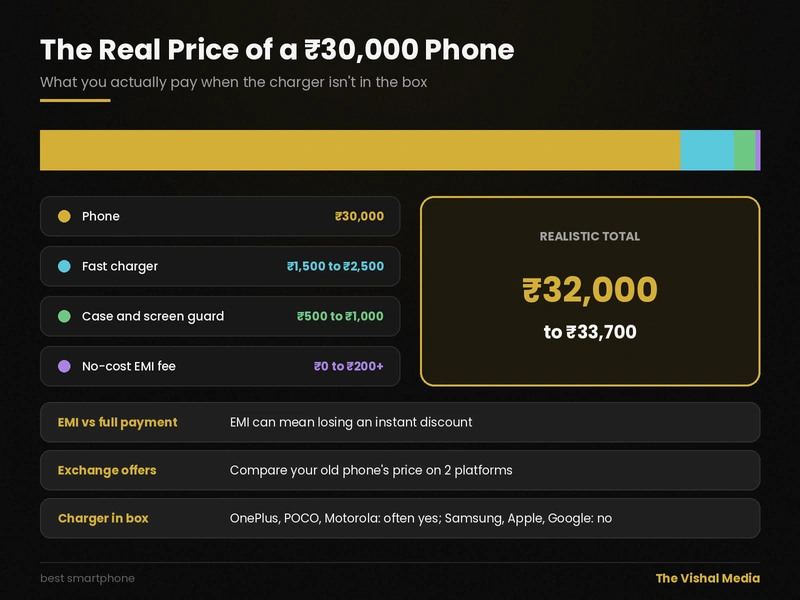
No-cost EMI: “no-cost” usually means the interest is given back as a discount. You may still pay a processing fee, and choosing EMI can mean losing an instant discount that’s only available on full payment. Compare both totals before you choose.
Exchange offers: check what your old phone would fetch on at least two platforms before accepting the store’s exchange price. The difference can be a few thousand rupees.
Charger in the box: OnePlus, POCO and Motorola include fast chargers with most of their phones. Samsung, Apple and Google don’t, which quietly adds to their real price.
Imported and grey-market phones: a phone imported from abroad might look cheaper, but it may not carry an Indian warranty or support all Indian 5G bands. US iPhones, for example, are eSIM-only. Buy from the brand’s store or an authorised seller.
Specs That Matter vs Specs That Are Mostly Marketing
Megapixels: a 200MP camera isn’t automatically better than a 50MP one. Sensor size, lens quality and processing matter more. Look at real sample photos, especially low-light and indoor shots, before trusting the number.
Benchmark scores: AnTuTu numbers show raw chip power, but they don’t show how well a phone keeps that speed when it’s hot. DXOMARK scores are useful for comparing camera and battery behaviour, but they’re lab results and won’t reflect your personal taste in photos.
Refresh rate: a 120Hz refresh rate makes scrolling feel smoother than 60Hz or 90Hz, and you’ll notice it daily. Going from 120Hz to 144Hz is much harder to see.
AI features: live translation, call summaries and photo editing increasingly run on the phone’s own AI chip, called an NPU, which keeps your data on the device and works offline. Our explainer on what edge AI is and how it works breaks this down, and our comparison of edge AI vs cloud AI shows which features need the internet and which don’t.
Waiting for the “next big phone”: it’s tempting to hold off for a rumoured launch, but rumours often never turn into products. Our breakdown of when the Tesla phone will be released shows how far viral phone claims can drift from reality. If your current phone is failing, buy what’s on sale today.
Your Three-Step Phone Decision Plan
Still unsure which is the best smartphone for you? Narrow it down in three steps:
-
Fix your budget, including extras. Add the charger, case and any EMI fee to the phone’s price.
-
Divide the price by the years of updates left. Count from the launch date, not today, and compare the result across your shortlist.
-
Match the 5G bands to your SIM. Make sure n78 is listed, and n28 too if you use Jio or live outside a big city.
Tell us your budget and what you use your phone for most through our contact page, and we’ll suggest what to shortlist. For more practical guides, explore our technology section.
Disclaimer
Phone prices, bank offers and update policies in India change frequently, sometimes within weeks. The prices and update promises in this guide were collected from brand announcements and major Indian retailers, but always confirm the final price, warranty and update policy on the brand’s official website or an authorised store before paying. This guide contains no paid placements or affiliate links.