


Artificial intelligence has traditionally depended on a simple arrangement: data is collected on a device, sent to a remote data center, processed there, and the result is returned.
That model still powers many of the AI services people use every day. But it is not always the best option.
If an autonomous vehicle has to wait for a distant server before reacting to an obstacle, or a factory camera has to upload every video frame before identifying a defect, the delay can become a problem.
That is where Edge AI comes in.
Instead of sending every AI task to a centralized cloud, Edge AI puts AI processing closer to where the data is created — on devices, sensors, gateways, or nearby edge servers.
Quick answer: What is Edge AI?
Edge AI is the use of artificial intelligence models on or near the device where data is generated, allowing the system to process information locally instead of relying entirely on a remote cloud server.
The basic idea is simple:
Move the intelligence closer to the data.
This can reduce latency, reduce the amount of data that has to travel across a network, and allow some AI-powered systems to continue operating even when connectivity is limited.
Why Move AI to the Edge?
Consider a smart security camera.
A cloud-based system might capture video, upload it to a server, run an AI model there, and then return a result such as “person detected.”
That works, but it creates a dependency on network connectivity and adds a round trip between the camera and the cloud.
An edge-based camera can run an AI model locally.
The camera captures the image → the local processor runs inference → the system decides what happened.
The cloud may still receive important events, recordings, analytics, or model updates, but it does not necessarily have to process every frame.
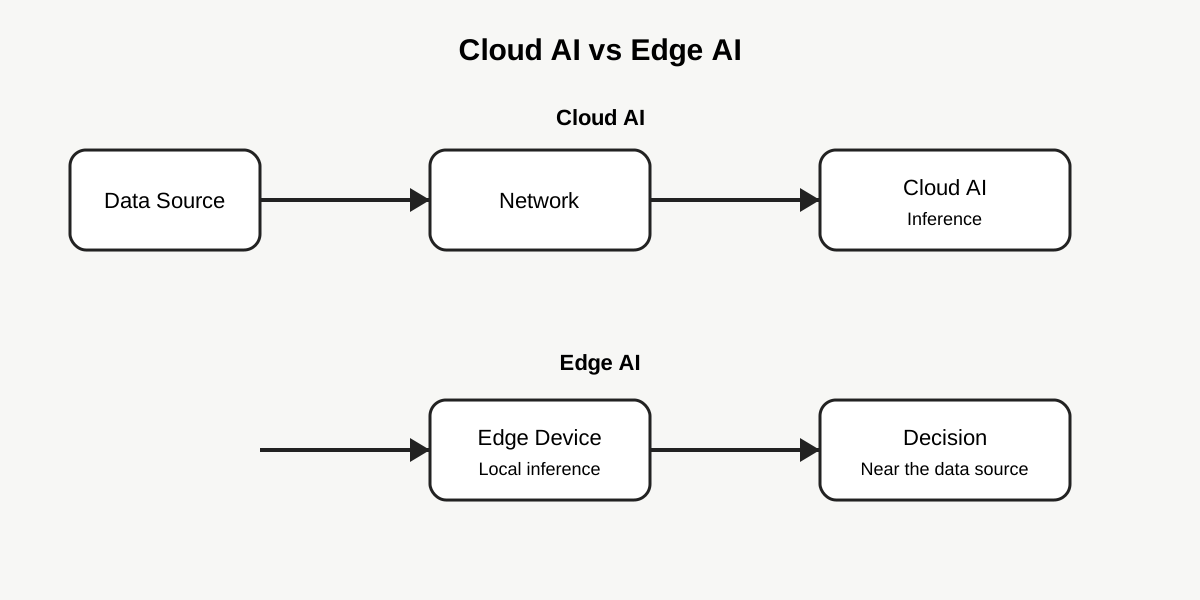
The difference
Traditional cloud flow
Camera → Internet → Cloud AI → Result → Device
Edge AI flow
Camera → Local AI inference → Result
This does not mean cloud computing is disappearing. In many real systems, the two approaches work together.
How Does Edge AI Work?
To understand Edge AI, it helps to separate two different parts of the AI lifecycle:
- Training
- Inference
Training is where a model learns patterns from large amounts of data. This often requires substantial computing resources and can happen in centralized data centers or cloud environments.
Inference is what happens when the trained model is used to make a prediction or decision.
For example:
- A model is trained to recognize objects.
- A camera captures an image.
- The trained model analyzes the image.
- The model predicts that the image contains a person.
That last step is inference.

Edge AI generally focuses on moving inference closer to the data source.
A simplified architecture looks like this:
Data source → Edge device → AI model → Local inference → Decision/action
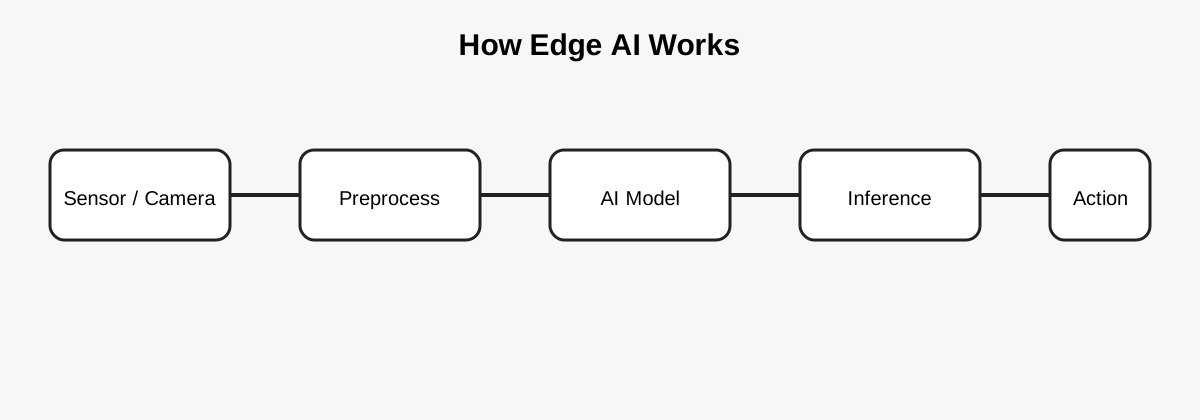
The edge device could be a smartphone, camera, vehicle computer, industrial controller, IoT gateway, or another computing system.
Edge AI vs Cloud AI
| Factor | Edge AI | Cloud AI |
|---|---|---|
| Where processing happens | On or near the device | Centralized cloud/data center |
| Latency | Usually lower | Depends on network round trip |
| Internet dependency | Can be reduced | Usually higher |
| Bandwidth use | Can reduce data transfer | Can require substantial data transfer |
| Compute resources | More limited | Much larger |
| Model size | Often constrained by device hardware | Can support larger workloads |
| Centralized management | More difficult across many devices | Generally easier |
| Best fit | Real-time/local decisions | Large-scale computation and centralized workloads |
The important point is not that one is universally better.
Edge AI is useful when proximity, responsiveness, connectivity, or local processing matters. Cloud AI is useful when centralized compute, large models, aggregation, and heavy workloads matter.
Many production systems combine both.
Where Is Edge AI Being Used?
Smartphones
Modern phones already perform many AI-powered tasks locally.
Examples include image enhancement, speech processing, biometric features, camera effects, and other on-device intelligence.
Local processing can make these experiences feel immediate and can reduce the need to send every piece of raw input to a remote server.
Smart Cameras
Computer vision is one of the clearest applications for Edge AI.
A camera can analyze video locally to detect objects, movement, defects, or other events.
Instead of continuously sending raw video to the cloud, a system may send only selected events, metadata, or clips.
That can reduce bandwidth requirements and make real-time responses easier.
Autonomous and Assisted Vehicles
Vehicles need to interpret information from cameras, radar, lidar, and other sensors.
Some decisions cannot comfortably depend on a round trip to a remote cloud service.
Local computing allows the vehicle to process sensor information and respond with very low latency.
Cloud infrastructure can still play an important role in areas such as fleet analytics, model development, mapping, software updates, and large-scale data processing.
Industrial Equipment
Factories can use AI-enabled edge systems for equipment monitoring, visual inspection, predictive maintenance, and process control.
A local system can analyze sensor or camera data close to the machinery.
This can be valuable when a fast response is important or when sending every raw data point to a central service would be inefficient.
Does Edge AI Replace the Cloud?
No.
This is one of the most important misconceptions about Edge AI.
In many real-world architectures, Edge AI and cloud AI complement each other.
A simplified hybrid architecture might look like:
Devices → Edge processing → Local decision
and then:
Important data/events → Cloud → Analytics, storage, training, monitoring, updates
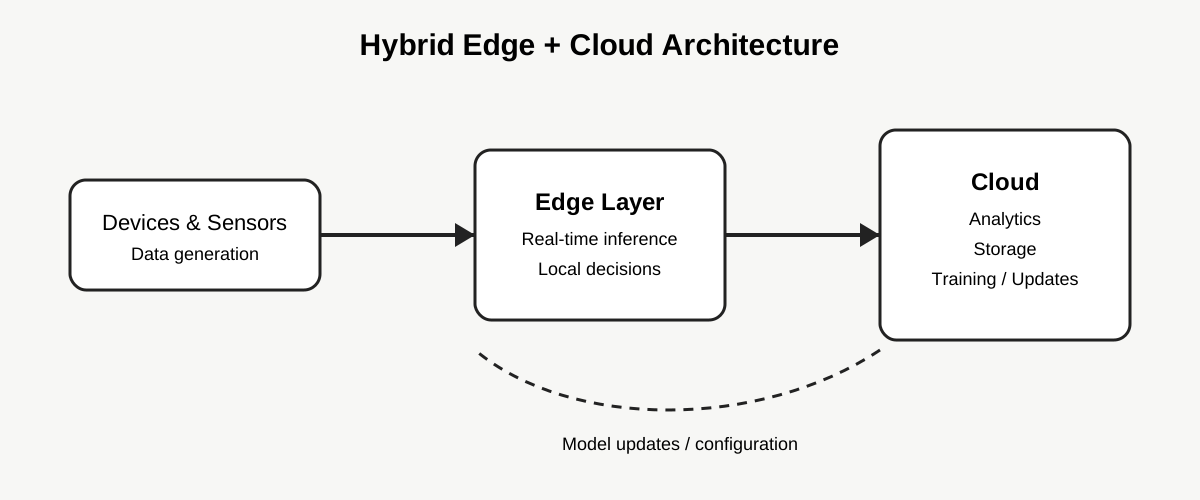
The edge handles tasks where local speed or connectivity matters.
The cloud handles workloads that benefit from centralized computing and large-scale resources.
This creates a hybrid model rather than a competition between the two.
The Main Advantages of Edge AI
1. Lower latency
When computation happens closer to the data source, the system does not always have to wait for a remote server.
That can be important for applications where decisions need to happen quickly.
2. Lower bandwidth requirements
Instead of continuously uploading raw data, a device can process information locally and send only useful results.
For systems producing large amounts of sensor or video data, this can be significant.
3. Better resilience
Some edge systems can continue performing important functions when connectivity is weak or temporarily unavailable.
4. Greater local data control
Processing information locally can reduce the need to send raw data elsewhere.
However, local processing should not automatically be treated as a guarantee of privacy or security. Device security, model protection, data handling, and system architecture still matter.
5. Real-time decision making
Applications that need immediate responses can benefit from having inference close to the point where data is generated.
The Challenges of Edge AI
Edge AI also introduces its own engineering problems.
Hardware limitations
A small device does not have the same compute, memory, storage, or thermal capacity as a large cloud data center.
AI models may therefore need to be optimized for the target hardware.
Model size
Large models can be difficult to run efficiently on constrained devices.
Techniques such as quantization, pruning, compression, and hardware acceleration can help, depending on the workload.
Device management
Deploying one AI model to one device is easy compared with deploying and maintaining models across thousands or millions of devices.
Organizations have to think about:
- Model updates
- Version management
- Monitoring
- Security
- Hardware differences
- Rollbacks
- Failure handling
Security
Moving computation to the edge changes the security model.
A cloud server is typically operated in a controlled environment. An edge device may be physically accessible, distributed across locations, and exposed to additional attack surfaces.
Security therefore has to be considered at the device, model, network, and application levels.
Is Edge AI the Future?
Probably — but not as a replacement for the cloud.
The more realistic future is hybrid AI infrastructure.
Some intelligence will live on devices.
Some workloads will run on nearby edge infrastructure.
Large-scale training, analytics, storage, and other compute-heavy workloads will continue to use centralized infrastructure.
The boundary between device, edge, and cloud will become increasingly important as AI moves into cameras, vehicles, industrial systems, smartphones, robotics, and other connected products.
The question is therefore not:
“Edge or cloud?”
It is:
“Which part of the AI workload should happen where?”
That architectural decision will depend on latency, connectivity, compute requirements, privacy, cost, reliability, and the specific application.
Frequently Asked Questions
What is Edge AI?
Edge AI is AI processing performed on or near the device where data is generated, allowing models to make predictions or decisions without sending every task to a remote cloud.
What is the difference between Edge AI and Cloud AI?
Edge AI processes data closer to its source, while Cloud AI generally processes workloads in centralized data centers. Edge AI can reduce latency and bandwidth use, while cloud infrastructure provides much larger centralized computing resources.
Does Edge AI need the internet?
Not always. Some edge systems can perform inference locally without a constant internet connection. Connectivity may still be needed for synchronization, updates, cloud analytics, monitoring, or other functions.
Is Edge AI more secure?
Not automatically. Local processing can reduce the movement of raw data, but edge devices introduce their own security challenges. Security depends on the complete architecture and implementation.
What devices can run Edge AI?
Examples include smartphones, smart cameras, industrial machines, IoT gateways, vehicles, robotics systems, and specialized AI-enabled hardware.
Why is Edge AI important?
Edge AI can make AI systems more responsive, reduce unnecessary data transfer, improve resilience, and enable intelligent processing in environments where continuous cloud connectivity is not practical.
The Bottom Line

Edge AI represents a shift in where artificial intelligence happens.
Instead of treating the cloud as the only place where intelligence can live, modern systems can distribute AI across devices, edge infrastructure, and centralized data centers.
For some applications, that means faster decisions.
For others, it means less network traffic or more resilient operation.
And for many production systems, it means something even more practical: using the cloud and the edge together, with each doing the work it is best suited to handle.
The future of AI may not be entirely in the cloud — or entirely on the device.
It may be everywhere in between.
Editorial Source Notes
Authoritative technical references and standards:
- National Institute of Standards and Technology (NIST): Publications on Edge AI architectures, distributed computing standards, and hardware trust frameworks.
- IBM Technology: Technical overviews of Edge Computing, Edge AI fundamentals, and Edge vs. Cloud workload distribution.
- IEEE Computer Society: Technical reports on edge intelligence, local inference acceleration, and model quantization.