
It’s 11 at night on NH-48. Your rear tyre has just burst, the phone shows 12% battery, and the only paper in the car is a crumpled slip from the last toll plaza. Somewhere in your memory sits a WhatsApp forward claiming that slip can summon a mechanic, an ambulance and free petrol within minutes. So what does the toll gate receipt backside actually offer, and what should you do in that moment?
At The Vishal Media, we went through the receipt field by field, checked what NHAI’s rules and fact-checkers say, and looked at how FASTag and barrier-free tolling are quietly replacing that paper slip. Here’s what’s real, what isn’t, and what to keep on your phone before your next highway trip.
Toll Gate Receipt Backside: A Field-by-Field Breakdown
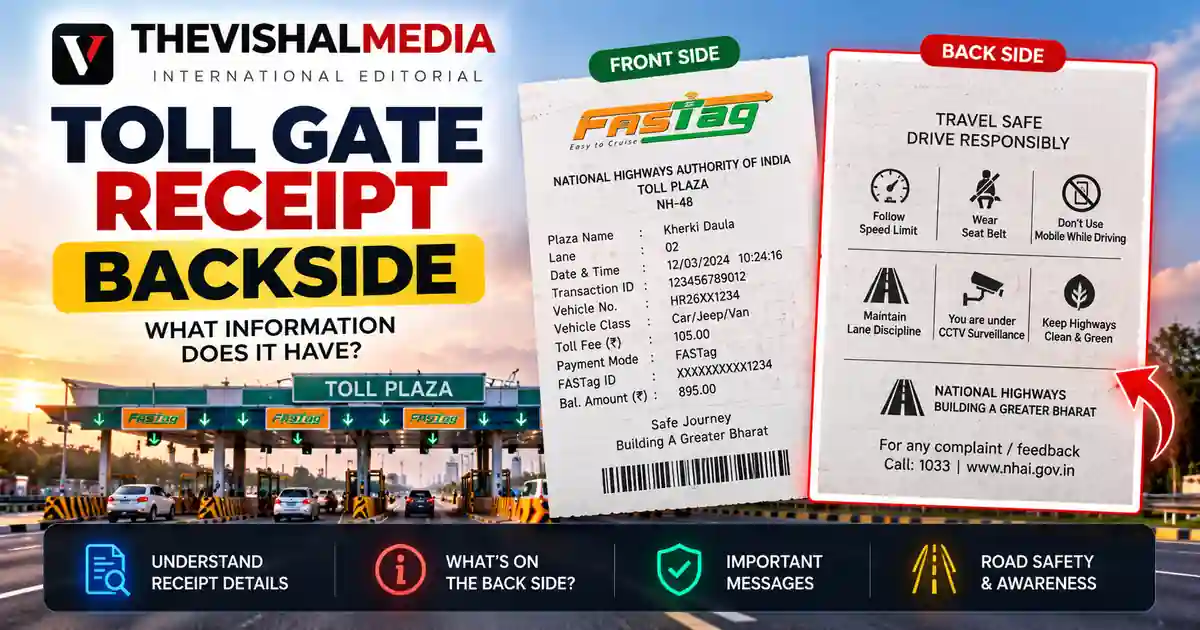
A national highway toll receipt is small, but almost every line has a job. Here’s what you’ll typically find on a printed slip:
| Field | What it tells you | Why it matters |
|---|---|---|
| Toll plaza name and location | Which plaza you crossed, often with the highway number and chainage (km point) | Helps you tell emergency services exactly where you are |
| Operator or concessionaire name | The company running the plaza | Useful if you need to complain about service |
| Vehicle class | Car, LCV, bus, truck and so on | Confirms you were charged the right category |
| Amount and journey type | Single trip, return trip or pass | Lets you check you weren’t overcharged |
| Date, time and receipt number | When you crossed | Works as proof for reimbursement or disputes |
| Helpline number | The plaza’s or highway helpline | Your first call in a breakdown |
| Ambulance number | Contact for the nearest highway ambulance | Medical emergencies |
| Crane or tow number | Recovery vehicle contact | Breakdowns and accidents |
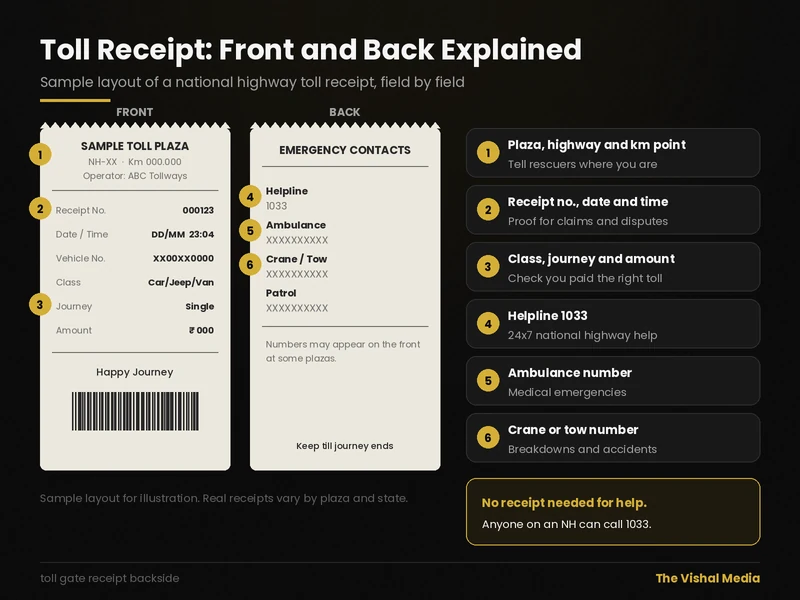
The emergency block is the part people mean when they search for the toll receipt emergency number or the back of a toll receipt. But here’s a detail most forwards skip: not every plaza prints these numbers on the back. Some put them on the front, below the amount. So if you flip your slip over and find it blank, check the other side before assuming the numbers are missing.
When the fact-checking site Factly collected receipts from several toll plazas, every one carried helpline numbers, and it noted that NHAI’s prescribed receipt format requires helpline, ambulance and crane contacts.
What Help You Can Actually Get (And What You Can’t)
The viral message mixes real highway emergency services with wishful thinking. This table separates them.
| Service | Available? | How to get it |
|---|---|---|
| Ambulance | Yes | Call the number on the receipt or 1033 |
| Crane or tow truck | Yes | Call the receipt number or 1033 |
| Highway patrol | Yes | Request through 1033 |
| Free petrol or diesel | No | Fuel may be arranged in some cases, but you pay for it |
| Tyre puncture repair | Not part of official services | Call a roadside assistance service or nearby mechanic |
| “Help within 10 minutes” | No official rule found | Response time depends on distance, traffic and vehicle availability |
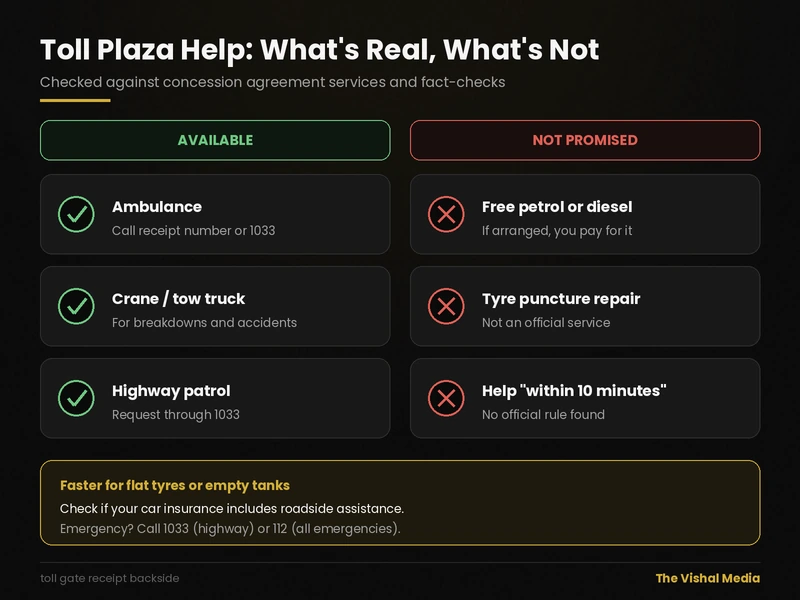
Ambulance, tow and patrol services exist because highway concession agreements require operators to provide them. Free fuel and guaranteed 10-minute arrivals don’t appear in those agreements. If your car insurance includes roadside assistance, that’s often the faster route for a flat tyre or an empty tank.
Do You Need the Receipt to Get Help? Call 1033 Instead
No. Emergency services on national highways are meant for every road user, whether you paid a toll, hold a pass or haven’t reached a plaza yet. The receipt is simply a convenient place where the numbers are printed.
The number to remember is 1033, the 24x7 national highway helpline run by Indian Highways Management Company Limited (IHMCL), an NHAI-backed company. It handles accidents, breakdowns and emergencies, and it also takes FASTag complaints. For a medical emergency or anything involving police, 112 works across India.
What to say when you call, so help reaches you faster:
-
Highway number and direction: “NH-48, going from Delhi towards Jaipur.”
-
Nearest landmark: the last toll plaza, a dhaba, a flyover or a petrol pump.
-
Kilometre stone: the small stones on the roadside show the highway number and distance. Reading out “km 142” pinpoints you far better than “somewhere after Neemrana.”
-
Vehicle details: number plate, colour and type.
-
The problem: puncture, engine failure, accident or medical emergency, and how many people are with you.
Lost the Receipt? How to Find Toll Plaza Numbers Fast
Receipts blow out of windows and get lost under seats. You still have options:
-
Call 1033 and ask for the toll plaza ambulance number or emergency services for your stretch.
-
Use NHAI’s Rajmargyatra app. It shows toll plazas, petrol pumps, hospitals and hotels along your route, and lets you report highway issues with geo-tagged photos.
-
Save numbers before you leave. Before a long drive, note the plazas on your route and save 1033 and 112 at the top of your contacts.
-
Download offline maps. Many highway stretches have weak signal, and an offline map still shows your location so you can describe it clearly.
FASTag Users: Where Your “Receipt” Lives Now
If your car has FASTag, you probably haven’t seen a paper slip in a while. That’s normal. FASTag tolls are deducted automatically, so a FASTag receipt is digital, and a printed slip isn’t guaranteed. Your proof of payment lives in three places instead.
1. The SMS alert. Every deduction triggers a message to your registered mobile number with the plaza name, amount and time. Don’t delete these after a trip; they’re your quickest proof.
2. Your FASTag issuer’s app or website. Open the app of the bank or wallet that issued your tag, go to the transaction or statement section, filter by date and download the history as a PDF. This is the document most offices accept for travel reimbursement.
3. The plaza’s display. Many plazas show the deducted amount on a screen as you pass. A quick dashcam clip or photo can help if you plan to dispute a charge.
Charged twice, or charged for a trip you didn’t take? Raise a complaint with your FASTag issuer or call 1033. According to NHAI’s FASTag FAQ, chargebacks for incorrect deductions normally take 20 to 30 working days, so keep the SMS and statement until the refund arrives.
One honest warning: editing a paper receipt or screenshot to claim more than you paid counts as misrepresentation. Your FASTag statement is a cleaner, verifiable record.
New Toll Rules That Change the Receipt Story
Three recent changes explain why the paper slip is fading, and they directly affect what you pay.
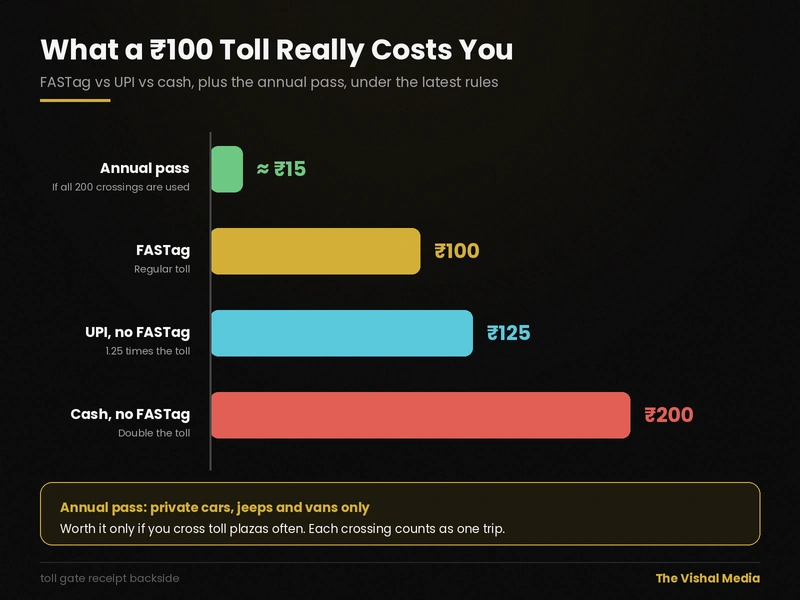
Without FASTag, UPI now costs less than cash. Paying at the booth for a toll receipt without FASTag has become more expensive. Under amended national highway fee rules, a vehicle without a valid FASTag pays double the toll in cash but 1.25 times the toll through UPI. On a ₹100 toll, that’s ₹200 in cash versus ₹125 by UPI, while a FASTag user pays ₹100. If your tag stops working, paying by UPI saves you real money.
The FASTag annual pass. Private cars, jeeps and vans can buy an annual pass for ₹3,075, valid for 200 toll crossings or one year, whichever comes first. Each plaza crossing counts as one trip, whatever its toll rate, so the pass suits regular highway drivers far more than occasional travellers.
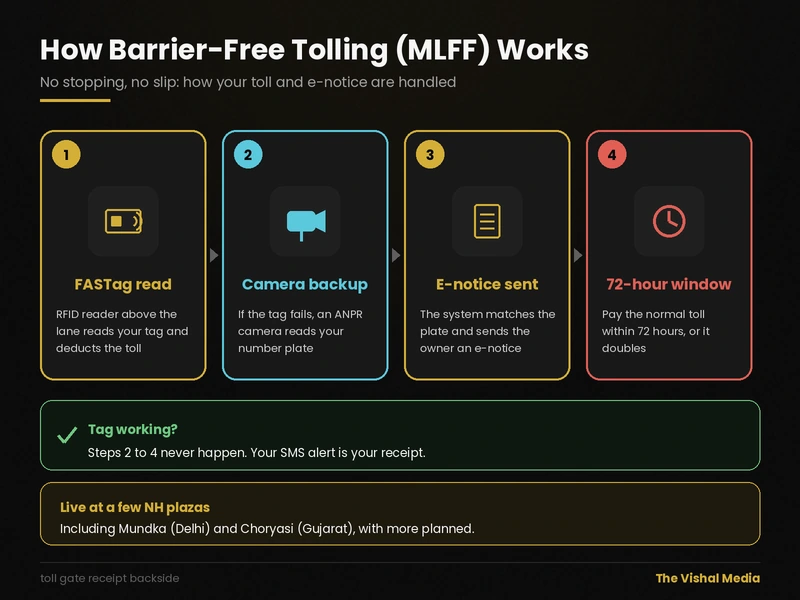
Barrier-free tolling has started. Officially called multi-lane free flow (MLFF), it’s live at a handful of national highway plazas, including Mundka in Delhi and Choryasi in Gujarat, there’s no barrier to stop at. The toll is deducted from your FASTag as you drive through. If the deduction fails because of a FASTag problem or an unreadable plate, the owner gets an e-notice and has 72 hours to pay before the toll doubles.
Put together, these changes mean the “receipt” of the near future is a text message, an app entry or an e-notice, not a slip of paper.
How Barrier-Free Tolling Works Behind the Scenes
From a technology point of view, barrier-free tolling is a neat combination of two technologies working together.
FASTag uses RFID. The sticker on your windshield holds a tiny chip and antenna. As you approach, a reader mounted above the lane sends out radio waves, the tag responds with its ID, and the system links that ID to your wallet and deducts the toll. It happens in a fraction of a second, without you rolling down a window.
Cameras act as the backup. Barrier-free lanes also use ANPR (automatic number plate recognition) cameras. These are AI cameras that read number plates using computer vision, often processing images right at the roadside so a decision doesn’t wait for a distant server.
The e-notice flow connects the two:
-
You drive through without stopping.
-
The RFID reader tries to read your FASTag.
-
If the tag fails, the ANPR camera captures your plate.
-
The system matches the plate to the vehicle record.
-
An e-notice is sent, and you get 72 hours to pay the normal toll.
It’s convenient, but it also means highway systems keep a digital record of where your vehicle travelled. That’s worth knowing, even if it rarely affects day-to-day driving.
Smart Habits Before Your Next Highway Trip
A two-minute check before you leave saves stress on the road:
-
Check your FASTag balance and KYC status in your issuer’s app. A blacklisted or empty tag means paying extra.
-
Do the annual pass maths. Count how many plazas you cross in a typical year. If it’s well below 200, a regular FASTag may work out cheaper.
-
Save 1033 and 112 as favourites on your phone.
-
Keep any paper receipt until the trip ends, and snap a photo of it so the numbers survive even if the slip doesn’t.
-
Planning a same-day return? The return-journey discount within 24 hours applies automatically when you pay with a working FASTag, so make sure your tag is active before you set out.
-
Pause before forwarding viral messages. Check claims like “free petrol at toll plazas” against official NHAI sources first.
Frequently Asked Questions
What is written on the back of a toll receipt in India?
Usually the emergency contacts: a helpline number, an ambulance number and a crane or tow number for that stretch of highway. Some plazas print these on the front instead, so check both sides.
Can I get free petrol at a toll plaza?
No. Toll plazas aren’t required to supply free fuel. If the helpline helps arrange fuel in an emergency, you’ll pay for it.
What is the 1033 helpline number used for?
It’s the national highway helpline for accidents, breakdowns and other emergencies, and it also handles FASTag complaints such as wrong deductions or a plaza failing to read your tag. It works 24x7.
How do I download a FASTag toll receipt?
Open your FASTag issuer’s app or website, go to transactions or statements, select the date range and download the history. The SMS alert you receive for each deduction also works as quick proof.
What happens if I pass a toll plaza without FASTag?
You pay double the toll in cash, or 1.25 times the toll if you pay by UPI. At barrier-free plazas, a failed payment leads to an e-notice that must be paid within 72 hours to avoid a doubled charge.
Is the FASTag annual pass worth it?
It’s worth it if you cross toll plazas often. At ₹3,075 for up to 200 crossings, it pays off quickly for daily highway commuters and frequent road-trippers, but occasional drivers may save more with a regular FASTag.
What is an e-notice at a barrier-free toll plaza?
It’s a digital toll bill sent when your FASTag payment fails at a barrier-free plaza. Cameras record your number plate, and you get 72 hours to pay the normal toll before it doubles.
Do I need to keep my toll receipt after the trip?
Keep it until your trip ends and any reimbursement or dispute is settled. For FASTag payments, your SMS alerts and issuer statement do the same job, so a paper slip isn’t essential.
Share the Facts With The Vishal Media
The toll gate receipt backside is useful, but it was never a magic ticket. The real safety net is knowing 1033, describing your location clearly and keeping your FASTag in good shape.
-
Share this article the next time a “hidden benefits of toll receipts” message lands in your family WhatsApp group.
-
Curious how those toll cameras read number plates? Read our guide on what is edge AI.
-
Seen another viral claim? Send it to us and The Vishal Media team will check whether it holds up, just as we did with the Tesla phone rumour.
-
Explore more in our technology guides.
Disclaimer
This article is based on publicly available NHAI information and credible reports. Toll rules, rates and emergency service arrangements can change, so please confirm the latest details with NHAI or your FASTag issuer. In an emergency, call 1033 or 112 immediately.