


Take 100 dinars. On 23 November 2026, the interbank rate on BookMyForex put them at about ₹29,809. Buying that many dinars in cash was quoted at ₹31,694 in Delhi. Selling the same notes back was quoted at ₹26,699. Same money, same city, almost ₹5,000 apart.
That gap is the real story behind 1 Kuwaiti dinar in Indian rupees. This guide from The Vishal Media gives you today’s KWD to INR rate with its date, explains why the number on a converter is not the number in your hand, and then splits into the two situations that bring most people here: sending dinars home from Kuwait, and holding leftover dinars in India.
1 KWD in INR today, with the date
On 23 November 2026 at 16:12 UTC, XE showed 1 KWD at ₹297.88785, which rounds to ₹297.89. The same page showed 1 KWD at 3.20413 US dollars. The table below uses ₹297.888 as the rate.
| Kuwaiti dinar (KWD) | Indian rupees (INR) |
|---|---|
| 1 KWD | ₹297.89 |
| 5 KWD | ₹1,489.44 |
| 10 KWD | ₹2,978.88 |
| 50 KWD | ₹14,894.40 |
| 100 KWD | ₹29,788.80 |
| 200 KWD | ₹59,577.60 |
| 500 KWD | ₹1,48,944 |
| 1,000 KWD | ₹2,97,888 |
Going the other way, 1 INR is about 0.003357 KWD. So ₹1,000 buys about 3.36 KWD, ₹10,000 buys about 33.57 KWD and ₹50,000 buys about 167.85 KWD.
A static article cannot show a live rate, and rates move during the day. To work out your own number later, multiply your dinars by the latest rate from a converter that shows a time stamp. That last part matters. When we compared converter pages on the same day, the figures we saw ranged from about ₹298 to ₹310 per dinar, and not every page said when its number was taken.
Where the number comes from
The rate in the table is a mid-market rate, the midpoint between the buying and selling prices on global currency markets. No bank or exchange house gives you exactly this rate. It is the fairest yardstick, though, because you can use it to judge every quote you get.
The Kuwaiti dinar is divided into 1,000 fils. In May 2007, the Central Bank of Kuwait announced that the dinar was re-pegged to a basket of currencies. So “pegged to the dollar” is not the full picture. XE’s page shows 1 KWD at 3.20413 US dollars, down 0.16% over its latest week. The rupee rate moved more in the same stretch, with its 7-day range from ₹297.05 to ₹302.70, a spread of about 1.9%.
One more thing about the size of the number. A dinar being worth about 298 rupees says how the two currencies are denominated, not that a country’s economy is bigger. Compare rates by percentage change and by the final rupees received, not by how large the figure looks.
The rate on the screen is not the rate in your hand
XE says it plainly on its own page: the converter rate is for information, and you will not receive it when sending money. Here is what four different products were quoted at on the BookMyForex page on 23 November 2026, using its own interbank rate of ₹298.09 as the starting point.
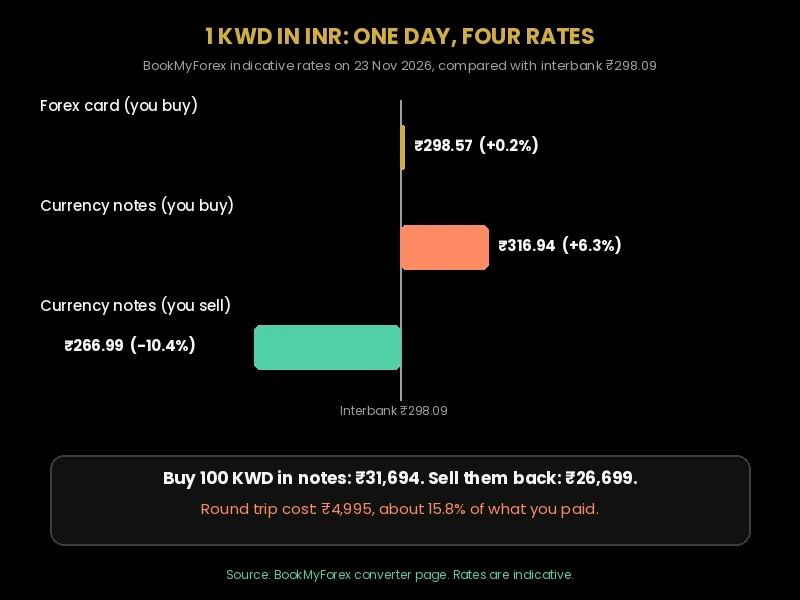
Two things stand out. A forex card rate of ₹298.57 sits only about 0.2% above the interbank figure. Currency notes are a different story. Buying 100 KWD in notes costs ₹31,694, which is ₹1,885 more than the ₹29,809 that 100 KWD is worth at the interbank rate. Selling 100 KWD in notes pays ₹26,699, which is ₹3,110 less. Buy and sell back, and the round trip costs ₹4,995, or about 15.8% of what you paid. Those percentages are our arithmetic on the page’s own numbers.
The city matters too. On the same page, buying notes was quoted at ₹316.94 in Delhi, ₹308.94 in Mumbai and ₹326.40 in Pune. For 100 KWD that is ₹31,694, ₹30,894 and ₹32,640, so the cheapest and the dearest of those three are ₹1,746 apart. Selling was ₹266.99 in Delhi, ₹294.49 in Mumbai and ₹269.50 in Pune. These are indicative quotes, and a dealer’s final price depends on the order.
If you live in Kuwait and send money home
Here the useful question is not “what is the rate?” but “how many rupees will reach the account?” The rate on the screen, the provider’s margin, the fee and the delivery method all feed into that one figure.
The rate keeps moving. XE’s statistics for 23 November 2026 put the 7-day range at ₹297.05 to ₹302.70, the 30-day range at ₹297.05 to ₹306.27 and the 90-day range at ₹297.05 to ₹311.81. Today’s ₹297.89 sits close to the bottom of all three. On a 200 KWD transfer, the 7-day high gives ₹60,540 and the 7-day low gives ₹59,410, a gap of ₹1,130 in a single week.
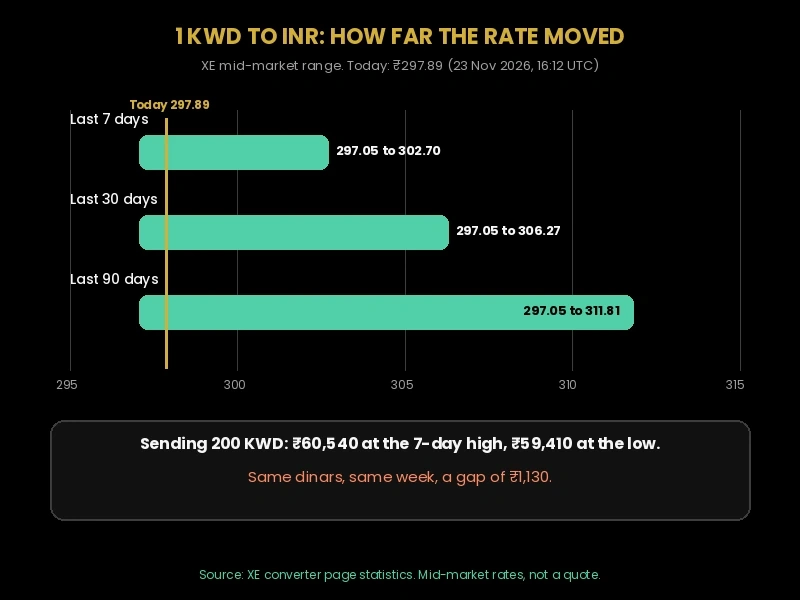
None of this tells you when to send. Nobody can predict the next move, and waiting for a better rate can also cost you. It only tells you why two transfers a week apart give different rupees, and why a quote needs a date.
Measure the margin. Take the mid-market rate and the rate the provider offers you, then work out the difference as a percentage:
(mid-market rate minus offered rate) divided by mid-market rate
For example, with a mid-market rate of ₹297.89 and an offer of ₹295.00 (an illustrative figure, not a quote), the margin is about 0.97%. On 200 KWD that is roughly ₹578. Add any fixed transfer fee on top to see the true cost.
Ask for the final amount in writing. None of the pages we read for this guide published a KWD to INR transfer fee. Some described it as depending on the amount and the payout method. LuLu Exchange’s page, for instance, says fees appear in its app before you confirm and mentions a limit of 9,999 KWD per month or per transaction for fully verified users. Whichever provider you use, read the limit and the fee before you start.
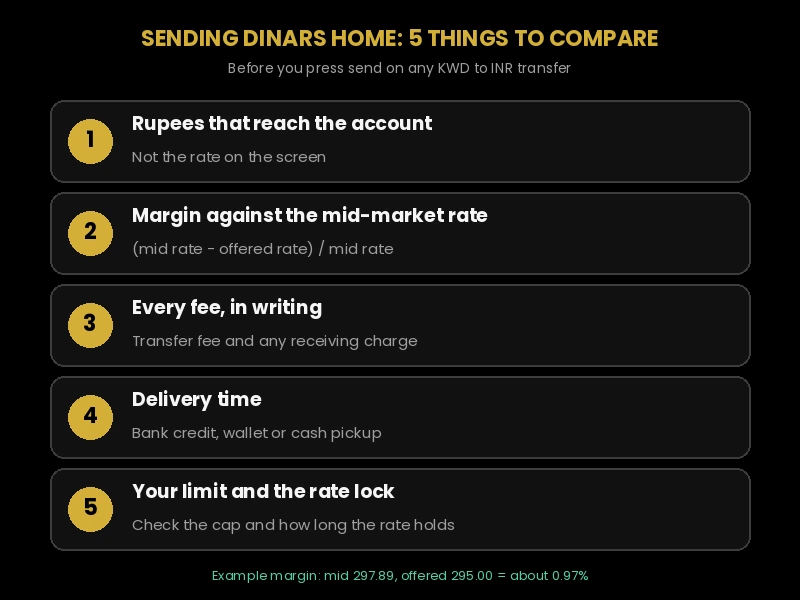
We do not recommend a particular provider. Use the five points above to compare two or three, and check that the account number and IFSC code of the person receiving the money are correct before you confirm. A wrong detail can delay the credit.
If you are in India with leftover dinars
Cash is the costly route, as the 100 KWD example showed. Before you sell notes, see what applies to you. The details below come from the BookMyForex FAQ and rules can change, so confirm them with the Reserve Bank of India or the customs department before you act.
- Selling notes: BookMyForex says you can sell unused notes and be paid by bank transfer after verification, with cash payout possible in some cases and subject to limits. It lists a passport and a PAN card as the documents needed.
- Time limit: under RBI rules as the page describes them, a resident returning from abroad should surrender unspent foreign exchange within 180 days, though notes and travellers cheques up to USD 2,000 may be kept beyond that.
- Customs: a Currency Declaration Form is needed if notes alone exceed USD 5,000, or notes and travellers cheques together exceed USD 10,000.
- Tax: the page says no TCS applies when you sell foreign currency for rupees.
- Forex card balance: the same page says a forex card balance does not expire and suggests keeping it for the next trip, not selling it at a poor rate.
A practical rule follows from the numbers earlier in this guide. If your leftover dinars sit on a forex card and you will travel to Kuwait again, keeping the balance may cost less than converting it to notes and selling them back, because the buy-and-sell gap on notes was about 15.8% in the figures we saw. If you hold notes and will not travel again, compare at least two or three dealers, because the same page showed quotes varying by city.
Which route fits you
| Your situation | What to compare | Watch out for |
|---|---|---|
| Sending salary or savings from Kuwait to India | Rupees received, margin, fees, delivery time | Limits per transaction, rate changes between quote and credit |
| Travelling from India to Kuwait | Forex card rate against notes | Notes carry the widest buy and sell gap |
| Leftover notes after a trip | Dealer quotes in your city, documents needed | Payout in cash may be limited |
| Just checking the value | A converter with a visible time stamp | Different pages show different numbers |
For a similar walk-through of another Gulf currency, our guide to Oman currency in Indian rupees shows how the same gap between the screen rate and the rate you receive plays out for the Omani rial.
Frequently asked questions
How many rupees is 1 Kuwaiti dinar today?
On 23 November 2026 at 16:12 UTC, XE showed ₹297.89 for 1 KWD. Check a converter with a time stamp for the latest figure, because the rate changes through the day.
Why do websites show different rates for 1 KWD?
They may use different sources, update at different times or show a product rate instead of the mid-market rate. A forex card, currency notes and a money transfer each carry their own margin.
How do I convert rupees to dinars?
Divide the rupee amount by the KWD to INR rate. At ₹297.888, ₹10,000 gives about 33.57 KWD.
Can I carry dinars into India?
BookMyForex states that a Currency Declaration Form is needed if notes exceed USD 5,000, or notes and travellers cheques together exceed USD 10,000. Confirm the current rule with the customs department before you travel.
Is a forex card better than notes for dinars?
On the BookMyForex figures from 23 November 2026, the forex card rate was within about 0.2% of the interbank rate, while notes carried a much wider buy and sell gap. Your own choice depends on fees, limits and where you will use the money.
Is there tax when I sell leftover dinars?
BookMyForex says no TCS applies when you sell foreign currency for rupees. Tax rules can change, so check with the RBI, your dealer or a chartered accountant.
What to do next
Write down the date and time next to any rate you see, then ask your dealer or provider for the exact rupee amount before you pay or send. If you spot a rate, limit or rule in this guide that has changed, tell us through the contact form and we will update it. For more plain-language money guides, browse the Finance section of The Vishal Media.
Disclaimer
This article is for general information only and is not financial, tax or legal advice. Exchange rates change throughout the day, and the figures here are snapshots from XE and BookMyForex on 23 November 2026 and may differ from what a bank, exchange house or dealer quotes you. We do not recommend any provider. Rules for carrying, surrendering or selling foreign currency can change, so confirm current details with the Reserve Bank of India, the customs department or a qualified professional. Read our full disclaimer.