


If you have read what Edge AI is, the next question is practical: for a given AI feature, should the model run on the device or in the cloud?
Quick answer: edge AI runs a trained model on or near the device that produces the data. Cloud AI runs it in remote data centers. Neither is better in general. The right choice depends on how fast the response must be, whether the system must work offline, where the data is allowed to go, how large the model is, and what the whole setup costs to run and maintain. Many real systems use both.
The question that decides it
The useful question is not “edge or cloud?” It is “which step of this workload should run where?”
Training a model and using it are separate steps. IBM notes that training usually happens in a centralized data center or the cloud because it needs large amounts of data, while edge devices typically run inference, the step where a trained model makes a prediction (IBM). That split already hints at the answer for most projects: the heavy learning stays central, and the quick decisions can move closer to the data.
Six criteria that decide where AI should run
1. Latency
Every request that goes to the cloud pays for a network round trip. For a photo filter or a document summary, a short delay is fine. For a machine that must stop, or a vehicle that must react, it may not be. If the decision cannot wait for the network, that points to the edge. IBM lists lower latency among the main benefits of running models locally (IBM).
2. Connectivity
A system on a factory floor, a farm or a moving vehicle may have a weak or interrupted connection. A model on the device keeps working when the link drops. The cloud depends on the connection being there, so if the feature must work offline, it favors the edge.
3. Data sensitivity
Processing data locally can mean raw data does not have to leave the device or site. That can help with privacy and with rules about where data may be stored. But local processing is not a guarantee of security: the device itself, the model and the update process all still need protection. Treat it as one factor, not a conclusion.
4. Model size and compute
Cloud data centers offer far more compute and memory than a camera or a phone. Large models usually need that capacity. Edge devices work within tighter limits, so models are often made smaller or optimized for the target hardware. IBM notes that small language models are expanding what can run on devices (IBM). If the task needs a large model, the cloud is usually the practical home.
5. Cost over time
Cloud AI is often billed by usage, so cost grows with the number of requests. Edge AI shifts cost toward hardware and ongoing device management. Which is cheaper depends on volume, on how many devices you run, and on how much data would otherwise travel over the network. IBM names reduced cloud cost for workloads that do not need immediate action as one benefit of the edge approach, but there is no universal break-even point. Run the numbers for your own situation.
6. Fleet management
One cloud model is easy to update and monitor in one place. Models on thousands of devices must be deployed, versioned, monitored, secured and sometimes rolled back across different hardware. If you do not have a plan for that, the operational burden can outweigh the benefits of running at the edge.
| Criterion | Question to ask | Leans edge when | Leans cloud when |
|---|---|---|---|
| Latency | How fast must the response be? | The decision cannot wait for a network round trip | A second or more of delay is acceptable |
| Connectivity | What if the connection drops? | The system must keep working offline or on a weak link | A reliable connection is always available |
| Data sensitivity | Where may raw data go? | Rules or policy keep raw data on the device or on site | Data can be sent to and stored in a managed environment |
| Model size and compute | Can the model fit on the hardware? | A compact or optimized model is accurate enough | The task needs a large model or heavy compute |
| Cost over time | What does each additional request or device cost? | Volume is high and the same model runs on many devices | Usage is low or uneven, so pay-as-you-go is cheaper |
| Fleet management | Who updates and monitors the models? | There is a plan to update, monitor and secure many devices | Central control and fast updates matter most |
A simple decision path
The flowchart below turns the criteria into three questions. A yes to any of them points to the edge. Three nos leave the cloud as the simpler default. If the edge is favored but the model is too large for the device, the usual answers are to shrink the model or split the work between edge and cloud.
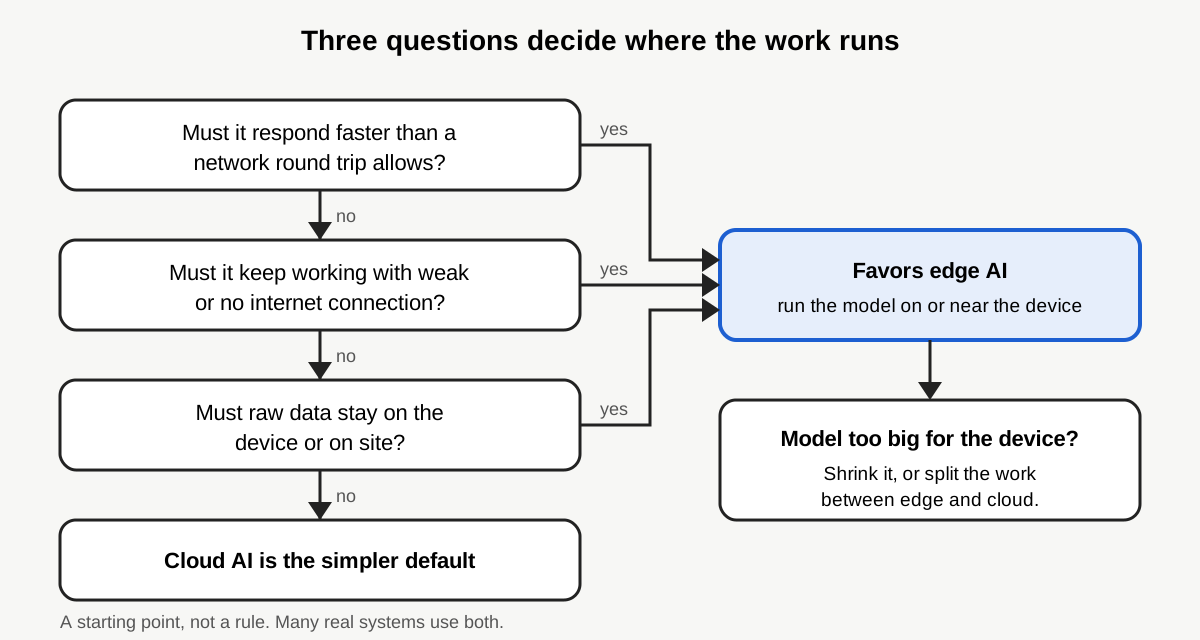
In text: if the response must be faster than a network round trip allows, choose the edge. If it must keep working with a weak or missing connection, choose the edge. If raw data must stay on the device or on site, choose the edge. Otherwise start in the cloud.
Hybrid patterns in practice
IBM describes edge and cloud as complementary: cloud AI provides storage and processing power for training and deploying advanced models, while edge AI handles tasks that need real-time responses (IBM). In practice that shows up in a few common patterns.
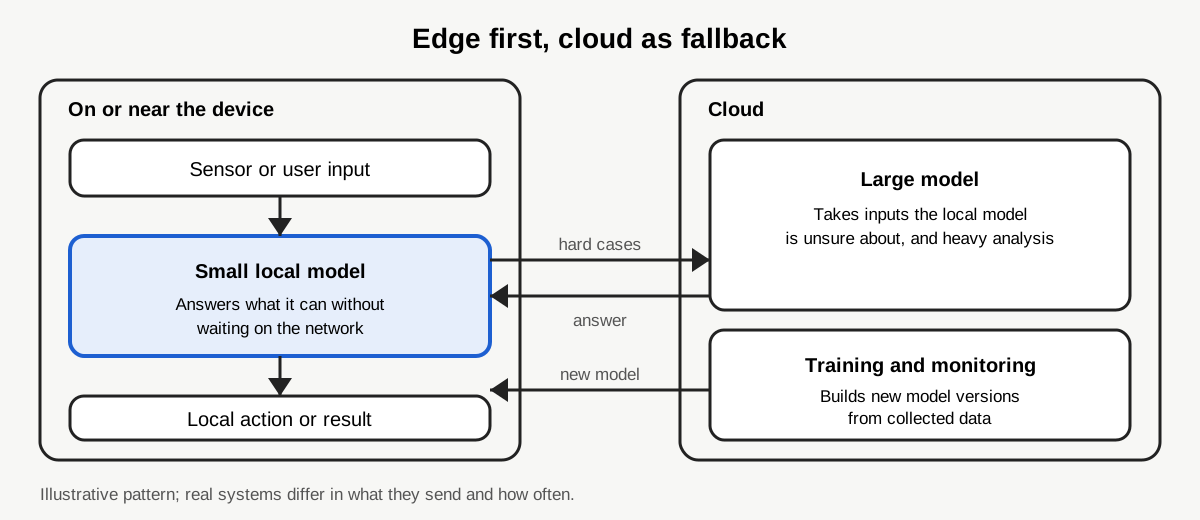
Edge first, cloud as fallback. A small local model handles what it can. Inputs it is unsure about are sent to a larger model in the cloud. IBM describes a related flow: when an edge model meets a problem it cannot handle, data goes back to the cloud for further training, and the improved model later replaces the one on the device.
Edge filtering, cloud analytics. The device processes raw data locally and sends only events or summaries upstream, so the cloud does analysis and storage on far less data.
Cloud training, edge deployment. Models are trained centrally, then packaged and pushed to devices to run inference locally. This is the default arrangement for many edge systems.
Learning without moving the data. Federated learning is an approach in which training data stays on the devices. Each device computes an update locally, and the updates are combined into a shared model. The idea was described in a 2016 research paper, motivated by data that is private, large, or both (McMahan et al.). It is a specialized technique and not a replacement for ordinary cloud training.
Common misconceptions
“Edge AI is always more private.” Local processing can reduce how much raw data travels, but devices can be physically accessed and attacked, so privacy depends on the whole design.
“Edge AI means no internet.” Many edge systems still use the network for updates, monitoring, synchronization or cloud analytics. They simply do not need it for every decision.
“The cloud is always slower.” For tasks where a short delay does not matter, the cloud’s extra capacity may give a better result overall. Speed matters only where the application needs it.
Frequently asked questions
Does edge AI replace cloud AI?
No. IBM describes them as complementary: the cloud is generally used for training and large-scale workloads, while the edge runs inference close to the data.
Which is cheaper?
It depends on usage volume, the number of devices and the cost of managing them. Cloud costs tend to rise with usage; edge costs shift toward hardware and operations. Estimate both for your own case.
Can I start in the cloud and move to the edge later?
Often yes. A common path is to prototype with a cloud model, then optimize and deploy a smaller version to devices once latency, cost or privacy needs are clear.
Does the choice change for large language models?
Large models typically need the cloud’s capacity, while smaller models can run on devices. This area changes quickly, so check current vendor documentation for what a given device can run.
The bottom line
Choose where each step of an AI workload runs by weighing latency, connectivity, data sensitivity, model size, cost and manageability. Use the cloud for heavy compute and central control, the edge for fast, local, resilient decisions, and a hybrid design when you need both.
