


Ask a bakery owner in Austin how sales are going and she will answer with a number. Ask the new hire she just brought on what he does all day and he will also say “sales.” Same word, two very different jobs. That small confusion causes real problems, from misread profit reports to job seekers who apply for roles they don’t understand.
If you’ve searched what is sales before, you probably landed on a page trying to sell you software. This guide from The Vishal Media skips the pitch. You will learn the sales meaning in each context, how a sale actually moves from stranger to customer, the formulas that tell you whether your selling works, the US rules sellers have to follow, and where AI fits in.
Sales Means Three Different Things (and People Mix Them Up)
The word shows up in three places, and each one answers a different question.
| Meaning | Question it answers | Who uses it | Example |
|---|---|---|---|
| Sales as an activity | “How do we win customers?” | Founders, sales reps, managers | A rep calling a dental clinic about payroll software |
| Sales as a number | “How much did we sell?” | Accountants, investors, owners | “Q3 sales were $412,000” on an income statement |
| Sales as an event | “Is it cheaper right now?” | Shoppers, retailers | A Labor Day mattress sale |
Why does this matter? Because a business owner who sees “sales up 20%” might assume the sales team is crushing it, when the jump actually came from a price increase or one large reorder. Knowing which meaning you are looking at keeps decisions honest.
The rest of this article focuses on the first two: selling as work, and sales as a number you can measure.
How the Sales Process Works, Step by Step
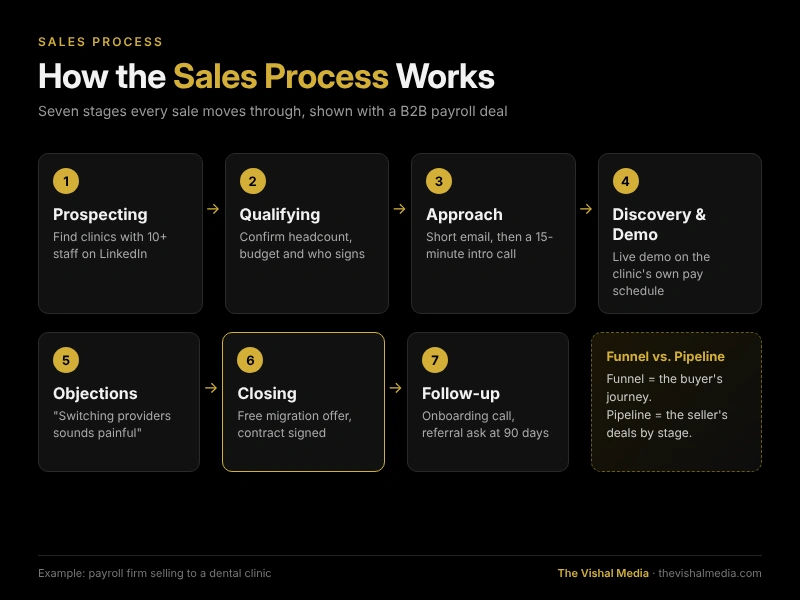
Every sales process follows roughly the same path, from prospecting and lead generation to closing, whether you sell $90 sneakers or a $60,000 software contract. What changes is how long each step takes and how many people get involved.
Here is the same seven-stage process across three very different US businesses:
| Stage | Running shoe store in Denver (B2C) | Payroll firm selling to a dental clinic (B2B) | Candle shop on Shopify (online) |
|---|---|---|---|
| 1. Prospecting | A runner walks in after seeing an Instagram post | Rep finds clinics with 10+ staff on LinkedIn | Shopper clicks a Pinterest pin |
| 2. Qualifying | Staff asks about weekly mileage and injuries | Rep confirms headcount, budget and who signs | Site shows price and shipping upfront, shopper self-qualifies |
| 3. Approach | Friendly chat at the fitting bench | Short email, then a 15-minute intro call | Welcome pop-up with a first-order code |
| 4. Discovery and demo | Gait check on the treadmill, two shoe options | Live demo using the clinic’s own pay schedule | Scent notes, burn time, customer photos |
| 5. Objections | “These cost $40 more than online” | “Switching providers sounds painful” | “What if I don’t like the smell?” |
| 6. Closing | 30-day run guarantee seals it | Free migration offer, contract signed | Easy returns policy, checkout completed |
| 7. Follow-up | Text reminder to replace shoes at 400 miles | Onboarding call, referral ask after 90 days | Review request email, restock reminder |
Notice how the online store handles most stages with page design rather than a person. That’s still selling. It’s just automated.
Sales funnel vs. sales pipeline
People use these terms interchangeably, but they look at the same journey from different angles. A sales funnel tracks the buyer’s side: how many people move from awareness to interest to purchase. A sales pipeline tracks the seller’s side: which specific deals sit at which stage and what action each needs next. Marketers tend to live in the funnel. Reps live in the pipeline.
Types of Sales You’ll Run Into
You don’t need to memorize a dozen labels. Most selling can be described with five pairs.
| Type | How it works | Typical cycle | Real example |
|---|---|---|---|
| B2B sales vs. B2C sales | Selling to businesses vs. to individual people | Weeks to months vs. minutes to days | Gusto selling payroll to companies vs. Target selling groceries |
| Inside sales vs. outside sales | Remote (phone, video, email) vs. in person | Varies | A SaaS rep on Zoom vs. a medical device rep visiting hospitals |
| Inbound sales vs. outbound sales | Buyer reaches out first vs. seller reaches out first | Inbound usually faster | A demo request form vs. a cold email campaign |
| Direct sales vs. channel sales | Selling yourself vs. through resellers or partners | Channel adds a middle layer | Apple Store vs. Apple products at Best Buy |
| Transactional vs. consultative selling | Quick, low-touch purchase vs. needs-first, advisory approach | Short vs. long | Buying printer ink vs. choosing a commercial roofing contractor |
Most businesses mix several types, and a good sales strategy matches the type to the customer. A software company might run inbound inside sales for small customers and outbound consultative selling for enterprise accounts, where the sales cycle can stretch for months.
The Math Behind Sales: Formulas Every Seller Should Know
This is where most guides stop at buzzwords. Let’s actually run the numbers.
Gross sales vs. net sales
Gross sales is the total value of everything you sold before any deductions. Net sales is what’s left after returns, discounts and allowances.
Net sales = Gross sales − Returns − Discounts − Allowances
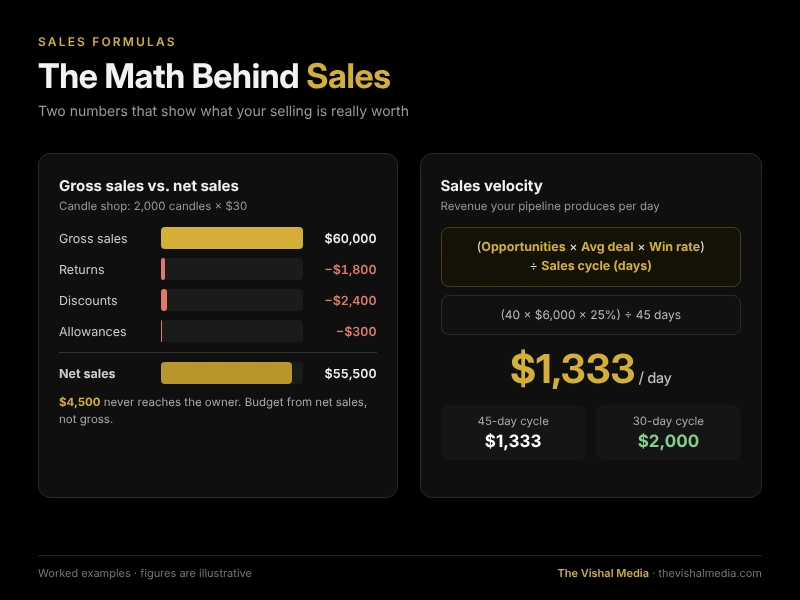
Example: the Shopify candle shop sells 2,000 candles at $30 each.
-
Gross sales: 2,000 × $30 = $60,000
-
Returns: 60 candles sent back = $1,800
-
Discounts: first-order codes used = $2,400
-
Allowances: partial refunds for chipped jars = $300
-
Net sales: $60,000 − $1,800 − $2,400 − $300 = $55,500
That $4,500 gap is money the owner never actually keeps. If she plans next quarter’s ad budget on gross sales, she overspends.
Sales vs. revenue
Sales revenue comes only from selling your products or services. Total revenue can include other income too, such as interest earned on cash, rental income from subletting office space or licensing fees. A bakery that also rents its kitchen to a caterer on weekends has more revenue than sales. For most small businesses the two numbers are close, but investors and lenders care about the difference.
Four metrics that show if your selling works
| Metric | Formula | What it tells you |
|---|---|---|
| Conversion rate | (Customers ÷ Leads) × 100 | How well you turn interest into buyers |
| Win rate | (Deals won ÷ Deals closed, won plus lost) × 100 | How often you beat the competition or the “do nothing” option |
| Average deal size | Revenue from won deals ÷ Number of won deals | Whether you’re selling bigger or smaller over time |
| Sales cycle length | Average days from first contact to closed deal | How long cash takes to arrive |
Sales velocity: the formula that ties it together
Sales velocity shows how much revenue your pipeline produces per day.
Sales velocity = (Number of opportunities × Average deal size × Win rate) ÷ Sales cycle length in days
Example: the payroll firm has 40 open opportunities, an average deal of $6,000, a 25% win rate and a 45-day cycle.
(40 × $6,000 × 0.25) ÷ 45 = $60,000 ÷ 45 = about $1,333 per day
The useful part is what happens when you change one input. Cut the cycle to 30 days with a faster onboarding offer and velocity jumps to $2,000 per day, without adding a single new lead.
Try it yourself: plug in your own last-quarter numbers before reading on. Want to come back to these formulas later? Add this guide to your Saved Articles list.
How Buyers Buy Now (and Why Selling Had to Change)
The biggest shift in selling isn’t a new technique. It’s the buyer.
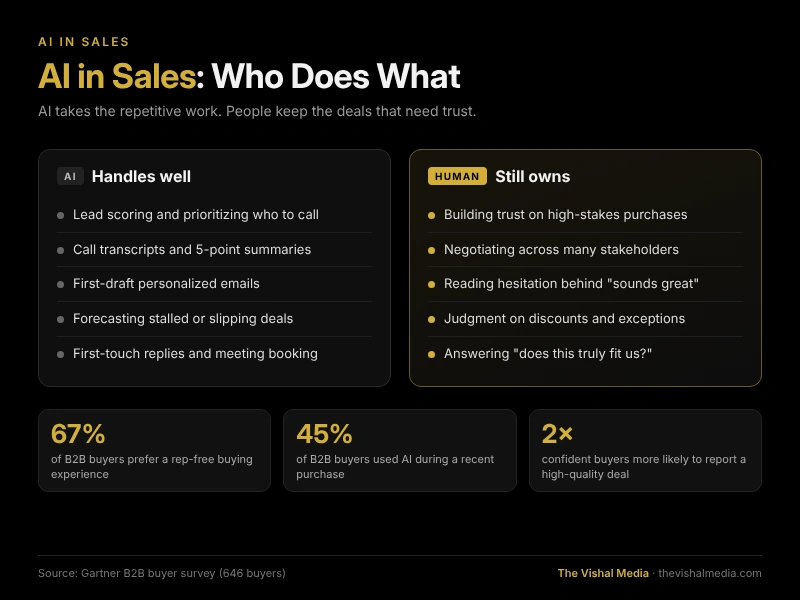
Gartner’s most recent survey of 646 B2B buyers found that 67% prefer a rep-free buying experience, and 45% said they used AI during a recent purchase. An earlier Gartner study found 73% of B2B buyers actively avoid suppliers who send irrelevant outreach. Consumers behave the same way: most people compare reviews, prices and YouTube demos long before they talk to anyone.
But buyers haven’t stopped wanting help. The same research shows they still want a seller’s input for one specific job: figuring out whether a product actually fits their situation. Gartner also found that buyers who feel confident in their decision are twice as likely to report a high-quality deal.
What that means in practice:
-
Publish what buyers want to know. Pricing ranges, setup time and honest “who this isn’t for” notes build trust before any call.
-
Show up for the fit question. The payroll rep’s real value isn’t reciting features. It’s mapping the clinic’s messy shift schedule onto the software.
-
Keep your story consistent. If your website says one thing and your rep says another, buyers notice and back off.
-
Write for AI readers too. Buyers increasingly ask AI assistants to summarize vendors, so clear, accurate pages on your site now shape first impressions.
AI in Sales: What It Handles and What Still Needs a Human
AI sales tools have moved from novelty to normal, and at The Vishal Media we try to explain them plainly rather than hype them.
What AI handles well today:
-
Lead scoring: ranking which leads are most likely to buy based on behavior and fit
-
Call transcription and summaries: turning a 40-minute discovery call into five bullet points and next steps
-
Email drafting: personalized first drafts a rep edits instead of writing from scratch
-
Forecasting: spotting deals that stall or slip based on activity patterns
-
AI SDR agents: handling first-touch replies and booking meetings around the clock
What still needs a person:
-
Building trust when the stakes are high, like a hospital choosing a records system
-
Negotiating with five stakeholders who each want something different
-
Reading the room when a buyer says “sounds great” but clearly means “not yet”
-
Making judgment calls about discounts, exceptions and long-term relationships
There’s also a privacy angle worth thinking about. Sales calls contain sensitive customer data, and where that data gets processed matters. Some newer tools run AI directly on the device instead of sending recordings to remote servers. If you want to understand that trade-off, our guide on what edge AI is and how it works explains the basics, and our breakdown of edge AI vs. cloud AI compares cost, speed and privacy side by side.
Selling as a Small Business Owner: A Simple First-Sale Framework
Most sales advice assumes you have a sales team, a CRM and a manager. If you’re a freelancer or a first-time founder, you are the whole sales department. Here’s a framework that works without any of that.
1. Pick one buyer, not “everyone.” A freelance bookkeeper in Ohio who says “I help small businesses” competes with thousands. One who says “I help landscaping companies with 5 to 20 employees” gets remembered and referred.
2. Write a one-sentence offer. Who you help, the problem you fix and the result. Example: “I help landscaping companies close their books by the 10th of every month, so owners stop guessing their profit.”
3. Have 20 real conversations. Not 20 posts. Twenty actual calls or coffees with people who fit your buyer. You’ll learn which problems they pay to fix, what they already tried and what words they use, which becomes your marketing copy.
4. Bring proof, even small proof. A before-and-after spreadsheet, a short testimonial or a free 30-minute review of their books beats any claim you can make.
5. Ask for a clear next step. “Would it help if I sent a proposal by Friday?” works better than “Let me know if you’re interested.”
Mistakes that cost founders their first deals:
-
Apologizing for the price instead of explaining the value
-
Talking about features when the buyer asked about results
-
Never following up because it feels pushy (a polite second email usually reads as professional, not pushy)
-
Saying yes to every buyer, including ones who will cost more to serve than they pay
US Sales Rules You Shouldn’t Ignore
Selling in the United States comes with federal rules, and fines can be steep. Here are the ones that trip up small teams most often.
TCPA (Telephone Consumer Protection Act). Covers telemarketing calls and texts. Key points: respect the National Do Not Call Registry, call consumers only between 8 a.m. and 9 p.m. their local time, and get prior express written consent before sending autodialed or prerecorded marketing calls or texts to cell phones. The FCC’s telemarketing guidance has the details.
CAN-SPAM Act. Covers commercial email, including B2B sales emails. You need honest subject lines and sender info, a valid physical postal address, a clear way to opt out, and you must honor opt-outs within 10 business days. The FTC’s CAN-SPAM compliance guide walks through each requirement.
FTC Cooling-Off Rule. If you sell door to door or at temporary locations like hotel rooms or fairgrounds, buyers get three business days to cancel. It applies to sales of $25 or more made at the buyer’s home and $130 or more at temporary locations. See the FTC’s Cooling-Off Rule page.
UCC Article 2. Most states have adopted Article 2 of the Uniform Commercial Code, which governs contracts for the sale of goods, including warranties and what happens when delivery goes wrong.
Many states add their own rules on top, such as state do-not-call lists or stricter consent requirements, so check your state attorney general’s website before launching any outbound campaign.
Sales as a Career: Roles, Pay and How People Get In
Sales jobs are everywhere, but pay varies wildly depending on what you sell and to whom.
Common roles in a sales team:
| Role | What they do |
|---|---|
| Sales development rep (SDR) | Researches and contacts prospects, books meetings |
| Account executive (AE) | Runs demos, negotiates and closes deals |
| Account manager | Grows and renews existing customer accounts |
| Sales engineer | Explains technical products to technical buyers |
| Sales manager | Coaches reps, sets targets and forecasts revenue |
What the pay data actually says. According to the latest BLS Occupational Outlook data, the median annual wage for sales occupations as a group was $38,530 in May 2025, below the $50,980 median for all occupations. That number is pulled down by retail and cashier roles, which make up the largest share of sales workers. The BLS mean wage for all sales and related jobs was $54,070 in May 2024, while sales engineers averaged $130,410. BLS also projects about 1.7 million openings in sales occupations each year, mainly from people leaving roles, even as overall employment in the group is expected to shrink over 2025 to 2035.
Understanding OTE and commission. Many B2B sales jobs advertise OTE, short for on-target earnings. It’s your base salary plus the sales commission you earn if you hit 100% of your sales quota. A job listing showing “$60K base, $120K OTE” means $60,000 is guaranteed and another $60,000 depends on performance. Always ask what percentage of the team actually hits quota, because OTE means little if almost nobody reaches it.
Getting in without a degree. Retail sales and many SDR roles don’t require a college degree. Hiring managers usually care more about coachability, resilience and clear communication. A common path is retail or customer service, then an SDR role, then account executive within 18 to 24 months for strong performers.
Sales Myths That Hold Beginners Back
“Great salespeople are born, not made.” Listening, asking good questions and following a process are learnable skills. Plenty of top reps were introverts who simply prepared better.
“Selling means being pushy.” Pushy tactics are exactly what modern buyers avoid. The best reps sound more like advisors who are comfortable saying “this isn’t a fit for you.”
“More activity always means more sales.” Volume helps only when it’s relevant. Gartner’s finding that most buyers avoid suppliers who send irrelevant outreach shows that spray-and-pray can actively hurt you.
“Good marketing makes sales unnecessary.” For low-cost consumer products, it often does. For a $50,000 equipment purchase with six decision-makers, someone still has to guide the deal over the finish line.
Frequently Asked Questions
What is the difference between sales and marketing?
Marketing creates attention and interest across a wide audience through ads, content and social media. Selling works one buyer or one account at a time to turn that interest into a signed deal. Marketing fills the top of the funnel; sales converts what comes through it.
Is sales the same as revenue?
Not exactly. Sales covers income from selling your products or services, while total revenue can also include interest, rent, royalties or other income. For a typical small shop the numbers are close, but they can differ a lot for companies with investments or licensing deals.
How do you calculate net sales?
Start with gross sales, then subtract returns, discounts and allowances. If a store sells $100,000 worth of goods, accepts $3,000 in returns and gives $2,000 in discounts, its net sales are $95,000.
Is sales a good career without a degree?
It can be. Many retail and entry-level SDR roles hire based on communication skills and drive rather than education. Earnings grow fastest in B2B roles with commission, especially in software, medical devices and technical products.
What does OTE mean in sales jobs?
OTE stands for on-target earnings: your base salary plus expected commission when you hit 100% of quota. Ask employers how many reps actually reach quota before comparing OTE figures across job offers.
Can AI replace salespeople?
AI is replacing parts of the job, like data entry, first-touch emails, meeting booking and call notes. Complex deals that need trust, negotiation and judgment still depend on people, and buyers say they want human input when deciding whether a product truly fits.
Your Next Move: Put These Sales Numbers to Work
Reading about sales is the easy part. This week, pull your last 90 days of numbers and calculate two things: your net sales and your sales velocity. The input that looks weakest (win rate, deal size or cycle length) is where your next improvement lives.
Then keep building your toolkit:
-
Save this guide to your Saved Articles so the formulas are one click away.
-
Get new guides first through the Vishal Media RSS feed.
-
See how AI is reshaping business tools in our technology and AI guides.
-
Sell for a living? Share what actually works by writing for us, or contact us with the sales topic you want covered next.
Disclaimer
This article is for educational purposes only and does not constitute legal, tax, financial or career advice. Sales regulations vary by state and change over time. Consult a qualified attorney or accountant before making compliance or financial decisions for your business. Salary figures are national statistics and may differ by location, industry and employer. Read our full site disclaimer.
Editorial Source Notes
- Gartner: Sales Survey Finds 67% of B2B Buyers Prefer a Rep-Free Experience (March 2026)
- Gartner: Sales Survey Finds 61% of B2B Buyers Prefer a Rep-Free Buying Experience (June 2025)
- U.S. Bureau of Labor Statistics: Sales Occupations
- U.S. Bureau of Labor Statistics: Recognizing sales workers on Salesperson Day
- FTC: CAN-SPAM Act: A Compliance Guide for Business
- FTC: Cooling-Off Rule
- FCC: Telemarketing, Robocalls, and Call Blocking
- National Do Not Call Registry
- Cornell Law School: UCC Article 2, Sales