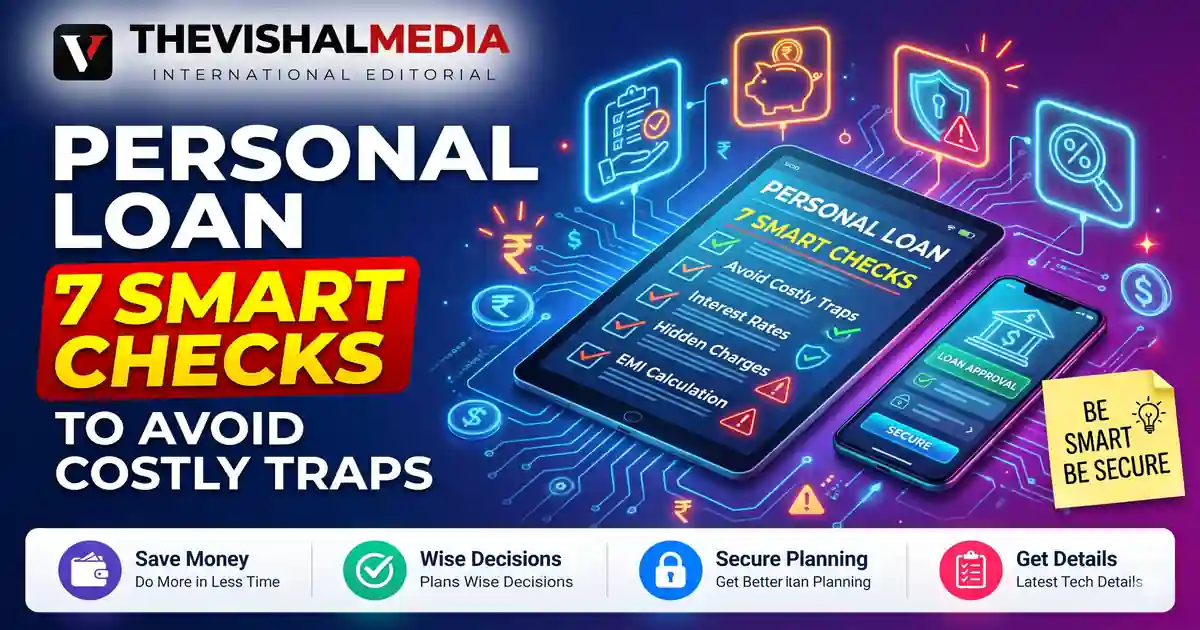

The 9.99% printed on a bank’s banner is a floor, not your rate. IDFC FIRST Bank and Axis Bank both advertise personal loan interest rates starting at 9.99% a year, yet IDFC’s own EMI calculator slider runs all the way up to 38%. So before you accept any loan personal loan offer, from a bank branch or a phone app, it pays to know what actually decides your number and what the fine print adds on top.
This guide walks through seven checks, in the order you would face them: comparing lenders, understanding your rate, reading the APR, the Key Fact Statement, the true total cost, app safety, and whether you need this loan at all.
What Lenders Really Offer: Rates, Amounts and Tenure Side by Side
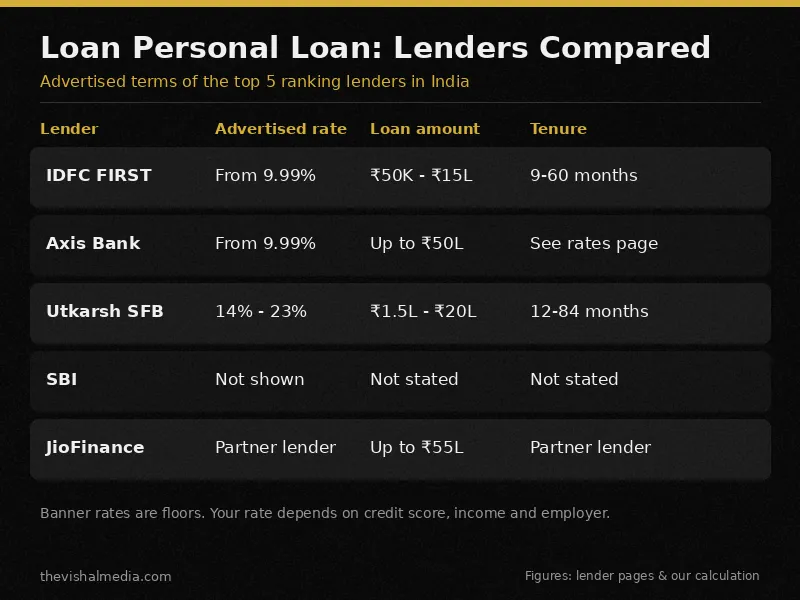
Every bank page you find on Google sells only its own product. Here is how the five top-ranking lenders compare when you put their published terms next to each other.
| Lender | Advertised rate | Loan amount | Tenure | Condition worth noting |
|---|---|---|---|---|
| IDFC FIRST Bank | From 9.99% p.a. | ₹50,000 to ₹15 lakh | 9 to 60 months | Zero processing fee and zero foreclosure on its FIRSTmoney loan; asks for a CIBIL score of 710 or more |
| Axis Bank | From 9.99% p.a. | Up to ₹50 lakh | Listed on its rates page | Details sit on separate rate and charges pages |
| Utkarsh Small Finance Bank | 14% to 23% p.a. | ₹1.5 lakh to ₹20 lakh | 12 to 84 months | Salaried only, minimum ₹20,000 net monthly income, age 23 to 58 |
| SBI | Not shown on its online application page | Not stated there | Not stated there | Interest on a daily reducing balance; Xpress Credit needs an SBI salary account |
| JioFinance | Set by the partner lender | Up to ₹55 lakh | Set by the partner lender | A marketplace that shows offers from multiple lenders |
Two things jump out. First, the cheapest-looking banners belong to banks that also have the strictest credit filters. Second, a public sector bank like SBI does not even print a number on its application page, which tells you rates there are decided case by case. Treat every figure above as a starting point and confirm it on the lender’s site on the day you apply, because banks revise these terms often.
How Loan Personal Loan Rates Are Actually Decided
A loan personal loan is unsecured, so the bank has nothing to sell if you stop paying. It prices that risk into your rate using four inputs.
Your credit score. CIBIL and other bureaus score you from 300 to 900. Most banks want 700 or above for their better rates, and IDFC FIRST spells out 710. Below that, approval is still possible at NBFCs, but expect a higher rate or a smaller amount.
Your income and FOIR. FOIR (fixed obligation to income ratio) is the share of your take-home pay already going to EMIs. Many lenders cap it near 50%. Say you take home ₹40,000 and already pay a ₹6,000 bike loan EMI. At a 50% cap, you have ₹14,000 of room, which supports roughly ₹4.15 lakh over three years at 13%. Ask for ₹6 lakh and the bank will either cut the amount or reject the file.
Your employer category. Banks grade employers. Government, PSU and large listed companies get the lowest personal loan interest rate bands; small private firms and startups land higher.
Your existing relationship. A salary account, a long savings history or a home loan with the same bank often unlocks a pre-approved instant personal loan at a better rate than a cold application.
Check 1: Read the APR, Not Only the Interest Rate
The interest rate tells you how fast your balance grows. The APR (Annual Percentage Rate) tells you what the loan really costs once fees are included, because fees come out of the money you receive while your EMI is calculated on the full sanctioned amount.
RBI now requires lenders to state the APR clearly, and when an app shows offers from several lenders, each offer must display the lender’s name, amount, tenure, APR, monthly repayment and any penal charges so you can compare them fairly. If an app shows only a monthly rate like “1.5% per month”, convert it: that is 18% a year before fees.
Check 2: The Key Fact Statement Is the Only Page That Must Be Honest
Before a digital loan is finalised, the lender must hand you a Key Fact Statement (KFS) in a clear, digitally signed format. It lists the loan amount, APR, repayment schedule, penal charges, processing fees and the contact of the grievance officer.
Read three lines on it carefully:
- APR, to compare against every other offer you have.
- Penal charges. RBI rules say a late-payment penalty must be a separate charge, not extra interest added to your rate, and no further interest can be charged on that penalty.
- Cooling-off period. Under RBI’s Digital Lending Directions, you can exit a digital loan during a cooling-off window by repaying the principal and the proportionate APR with no penalty. The lender decides the window, but it cannot be shorter than one day, and the lender may keep a one-time processing fee only if the KFS discloses it.
That cooling-off line is useful if you borrow in a hurry and find a cheaper offer the next morning.
Check 3: Work Out the Total Cost With Real Numbers
Here is a worked example we calculated for a common borrowing size. Loan: ₹2 lakh. Rate: 13% a year. Tenure: 3 years. Processing fee: 2% plus 18% GST.
| Item | Amount |
|---|---|
| EMI | ₹6,739 |
| Total interest over 3 years | ₹42,596 |
| Processing fee (2%) | ₹4,000 |
| GST on fee (18%) | ₹720 |
| Money that actually reaches your account | ₹1,95,280 |
| Everything you pay beyond the ₹2 lakh | ₹47,316 |
| Effective APR on the money received | About 14.7% |
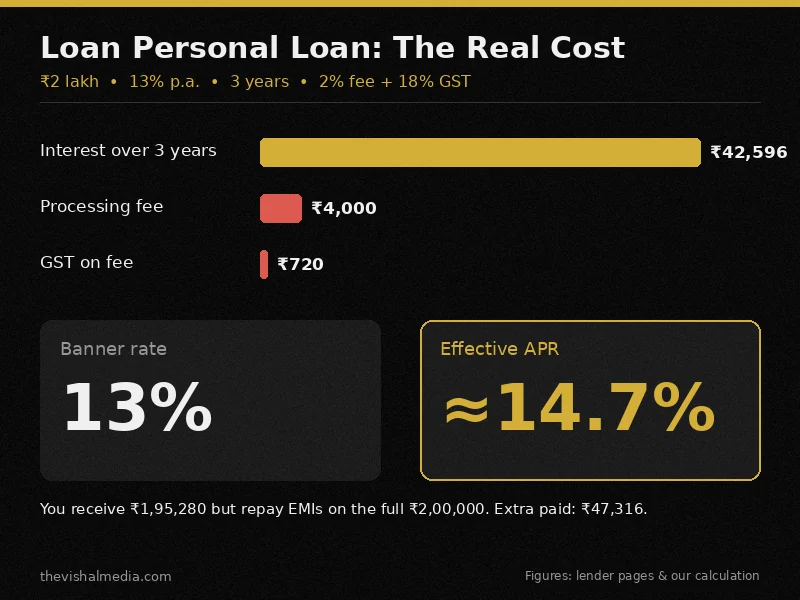
So a “13% loan” costs closer to 14.7% once the fee is counted. The tenure changes the picture even more:
| Tenure | EMI | Total interest |
|---|---|---|
| 2 years | ₹9,508 | ₹28,201 |
| 3 years | ₹6,739 | ₹42,596 |
| 4 years | ₹5,365 | ₹57,544 |
| 5 years | ₹4,551 | ₹73,037 |
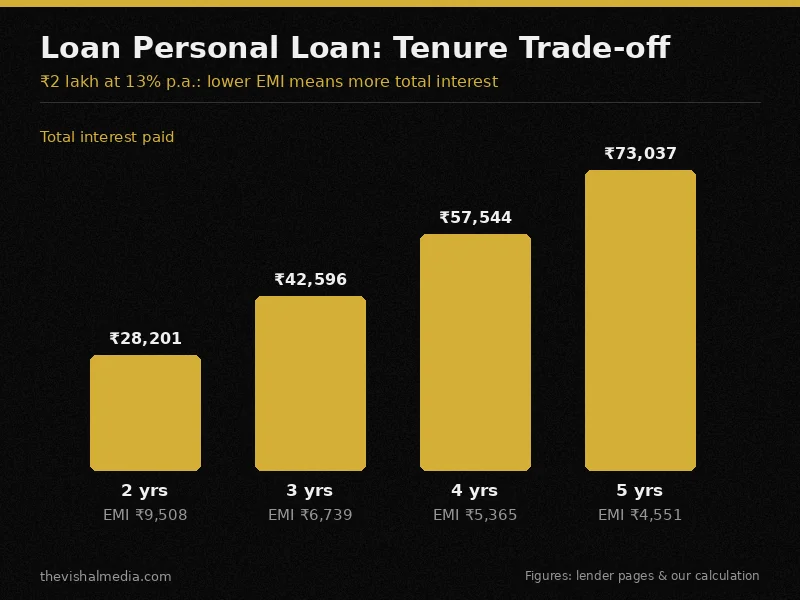
Stretching from two years to five cuts the EMI by more than half but adds about ₹45,000 in interest. Pick the shortest tenure whose EMI still fits comfortably under your FOIR.
Foreclosure math. Suppose you close this loan after 12 EMIs. The outstanding balance would be about ₹1,41,744. A 3% foreclosure fee plus GST costs roughly ₹5,017, while the interest you avoid on the remaining 24 EMIs is about ₹19,987. Closing early still saves you around ₹15,000. Some lenders, like IDFC FIRST on FIRSTmoney, charge nothing for foreclosure, so check this line in the KFS before you sign.
Check 4: Make Sure the Personal Loan App Is Genuine
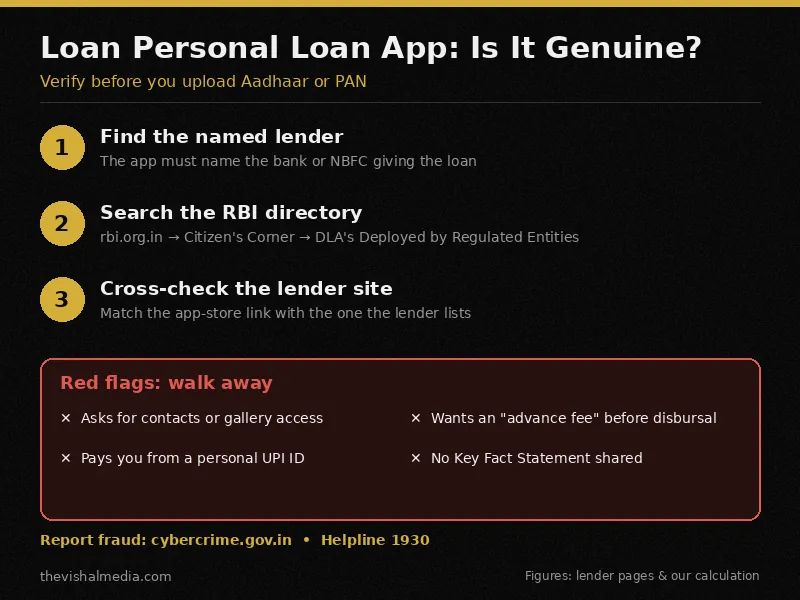
This is where most borrowers get hurt, and it is the part bank pages skip. Fake lending apps copy real brand names and logos, approve “loans” within minutes, then harvest your contacts and photos for recovery harassment.
RBI now runs a public directory of Digital Lending Apps that lists every app deployed by its regulated banks and NBFCs. The list is built from what lenders themselves report to RBI and updates automatically when they add apps. Verify any personal loan app in three steps:
- Find the named lender. A genuine app tells you which bank or NBFC actually gives the loan. If the app hides this, stop there.
- Search the RBI directory. On the official RBI website, open “DLA’s Deployed by Regulated Entities” under Citizen’s Corner, search the app’s name and confirm it appears under that same lender.
- Cross-check the lender’s own site. Lenders must list their digital lending apps on their websites. Compare the app-store link with the one the lender publishes, because clones often use near-identical names.
Remember that the directory confirms a link between an app and a regulated lender. RBI does not “approve” apps itself, so an app showing “RBI approved” in its banner proves nothing.
Red flags that should end the conversation: the app asks for access to your contacts or gallery, demands an “advance fee” before disbursal, sends money from a personal UPI ID, or offers no KFS. If you have already been targeted, report it on the National Cybercrime Reporting Portal or call the 1930 helpline.
Before You Tap “Apply”, Send This to One Person
Personal loan decisions are often made late at night, on a phone, under pressure. If someone in your family or friend circle is about to borrow, share this guide with them first. The two checks that save the most money and trouble take under ten minutes:
- Ask the lender for the KFS and compare APRs, not banner rates.
- Search the app in RBI’s directory before uploading Aadhaar or PAN.
We cover fintech apps and digital tools at The Vishal Media, so if a loan app’s permissions or behaviour looks odd to you, write to us through the contact page and we will look into it for a future guide. You may also find our explainer on finding a bank IFSC code handy when you link a repayment account.
Check 5: Protect Your Credit Score While You Shop
Every formal loan application triggers a hard enquiry on your credit report. One or two are normal. Five applications in a fortnight look like credit hunger to the next lender, and that alone can push your file into rejection.
Shop smarter instead:
- Use pre-approved or “check your offer” journeys inside your own bank’s app first, since those usually rely on data the bank already has.
- Apply formally only after you have shortlisted one or two lenders on APR.
- If you are rejected, wait, fix the reason, and pull your free credit report from a bureau to check for errors before trying again.
Common rejection reasons are a score below the lender’s cut-off, FOIR above its cap, frequent job changes, a late payment in the last year, or a mismatch between your stated and verified income. Banks increasingly run these checks through automated, AI-driven credit models, so small inconsistencies in your form get caught quickly.
Check 6: Borrowers the Banks Tend to Overlook
Most bank pages assume a salaried applicant with payslips. If that is not you, personal loan eligibility works a little differently.
Self-employed. Several bank schemes, including Utkarsh’s personal loan and SBI’s Xpress Credit, are built for salaried borrowers only. Self-employed applicants usually need two to three years of ITRs, business bank statements and GST returns where applicable, and NBFCs are often more flexible than banks here.
No salary slip. If your employer pays you through bank transfer without formal slips, six months of bank statements showing regular salary credits, plus Form 16, can often stand in. Cash salaries are much harder to finance.
First-time borrowers. With no credit history, there is no score for the bank to read. Starting with a small amount, adding a co-applicant with a good score, or building a short record first through a secured card can open better offers later.
Check 7: Do You Need a Loan Personal Loan at All?
The honest question no bank page asks. An unsecured personal loan is one of the most expensive ways to borrow, so compare it with options you may already have:
- Gold loan. Secured against jewellery, so rates are usually lower and approval is quick, though you risk the gold if you default.
- Loan against a fixed deposit. Banks typically price it a little above your FD rate, and your deposit keeps earning interest.
- Top-up on an existing home loan. If you already have a home loan, a top-up is usually priced near home loan rates, far below most personal loan rates.
- Credit card EMI conversion. Convenient for a single purchase, but check the effective rate and processing fee before assuming it is cheap.
If none of these fit and the need is genuine, such as a medical bill or an urgent repair, a personal loan from a regulated lender with a clear KFS is a reasonable tool. If the purpose is a gadget upgrade or a holiday, saving for a few months will almost always cost less.
Frequently Asked Questions
Which bank gives the lowest personal loan interest rate in India?
Among the top-ranking lenders, IDFC FIRST Bank and Axis Bank both advertise starting rates of 9.99% a year. Those floors go to applicants with strong scores and preferred employers. Compare the APR quoted to you personally, because two banks with the same banner rate can offer you very different deals.
Can I get a personal loan with a 650 CIBIL score?
It is harder but not impossible. Most banks look for 700 or above, so at 650 you will mostly see offers from NBFCs, usually at higher rates or for smaller amounts. Adding a co-applicant with a better score, choosing a secured option like a gold loan, or improving your score for a few months first can all work better.
How do I know if a loan app is RBI registered?
Find the bank or NBFC named in the app, then search the app on the “DLA’s Deployed by Regulated Entities” list on rbi.org.in and confirm it sits under that lender. If the app names no lender, or does not appear on the list, do not share your documents.
Can I close my personal loan before the tenure ends?
Yes, most lenders allow foreclosure, but charges vary. Some, like IDFC FIRST on FIRSTmoney, charge nothing, while others charge a percentage of the outstanding balance plus GST. Run the numbers first: in many cases the interest you save is several times the fee.
Can I get a personal loan without a salary slip?
Often, yes. Lenders may accept bank statements showing regular salary credits along with Form 16. Self-employed borrowers typically submit ITRs and business bank statements instead.
How much personal loan can I get on a ₹25,000 salary?
If you have no other EMIs and the lender caps FOIR at 50%, you have about ₹12,500 of EMI room. At 13% over three years, that supports roughly ₹3.7 lakh on paper. Actual offers are often lower, and some lenders set a higher minimum income, such as Utkarsh’s ₹20,000 net monthly floor for its scheme, so eligibility differs by lender.
Disclaimer
This guide is for general information and does not replace advice from a qualified financial adviser. Interest rates, fees and eligibility rules change frequently and differ by lender and applicant. The calculations above use sample figures to show how costs work, so always confirm the terms in your own Key Fact Statement and on the lender’s official website before borrowing.