

A ₹500 profit on ₹10,000 of shares does not stay ₹500. About ₹38 goes to charges before tax even enters the picture, and most beginner guides never show you that number. This plan from The Vishal Media walks you through how to invest in share market step by step, with the real costs, the tax rules and the safety checks that decide whether your first month goes well.
Before you open any account: three checks
Open the account second and answer these questions first.
-
Is your emergency money safe? Keep money for bills and emergencies out of shares. NSE’s investor guide lists a savings account, money market funds and bank fixed deposits as short-term options, and shares as a long-term one.
-
Do you have an expensive loan running? Share returns are never guaranteed, while loan interest is. Clearing a high-interest debt first is usually the safer move.
-
How long can the money stay invested? Prices move with company performance and economic conditions, as SEBI’s own investor page warns. If you may need the money in a year or two, shares are the wrong place for it.
What you need to start
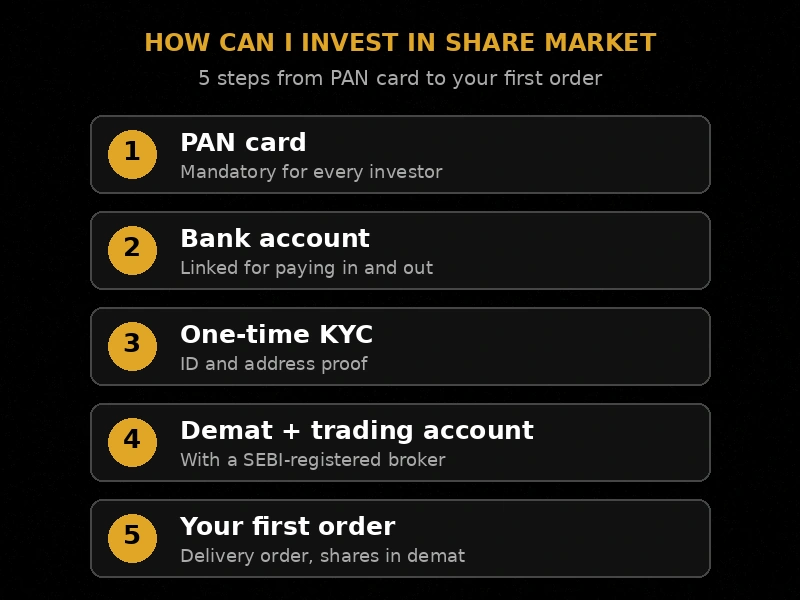
NSE’s getting-started guide is clear on the basics. A PAN card is mandatory for all investors. You also need a bank account, a demat account and a trading account, plus a one-time KYC with a SEBI-registered broker.
A demat account holds your shares electronically, the way a bank account holds your money. A trading account is what you use to place buy and sell orders, and it connects your bank account to your demat account. Many brokers and banks open both together, and the broker then gives you a unique client ID.
You cannot place orders on the exchange by yourself. You need a trading account with a registered broker, even though the demat account itself is opened with a depository participant.
How to choose and verify a broker
We do not recommend a particular broker here, because the right fit depends on the charges you will actually pay. Use this checklist instead.
-
Check the registration. A genuine broker shows its SEBI registration number on its website. NSE also has a “locate your stock broker” tool on its site.
-
Ask for the full rate card in writing. You want brokerage on delivery trades, account opening and yearly charges, and the DP charge that applies when you sell.
-
Remember that KYC is a one-time exercise. Once it is done through one registered intermediary, you do not have to repeat it with another.
-
Walk away from anyone who asks for your login details or offers to “manage” your account for a fee.
The real cost of your first trade
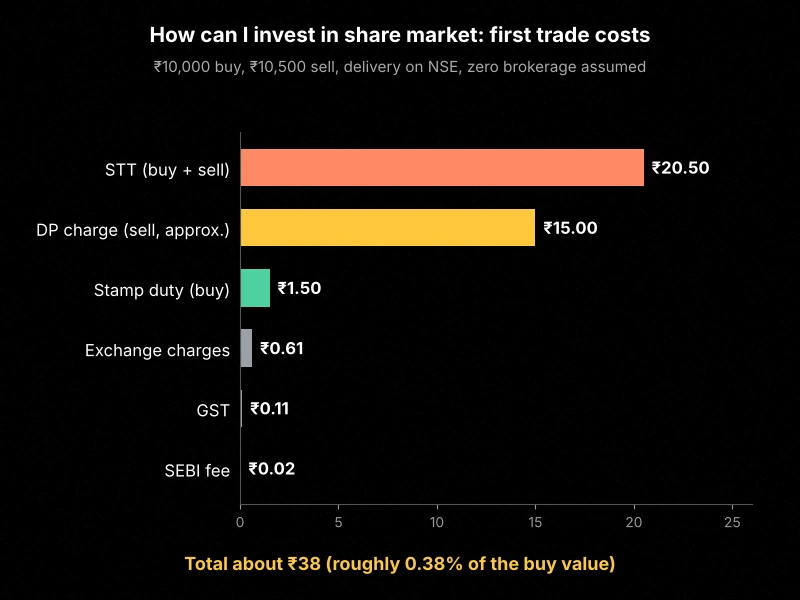
Most platforms advertise free account opening. That does not make a trade free. Here is a worked example: you buy ₹10,000 of shares for delivery on NSE and sell them later for ₹10,500, with a broker that charges zero delivery brokerage.
| Charge | On the buy (₹10,000) | On the sell (₹10,500) |
|---|---|---|
| STT, 0.1% | ₹10.00 | ₹10.50 |
| Stamp duty, 0.015% (buy side only) | ₹1.50 | None |
| NSE transaction charge, about 0.00297% | ₹0.30 | ₹0.31 |
| SEBI turnover fee, ₹10 per crore | ₹0.01 | ₹0.01 |
| GST, 18% on exchange and SEBI charges | ₹0.06 | ₹0.06 |
| DP charge (sell side, approximate) | None | About ₹15 |
| Total | About ₹11.87 | About ₹25.88 |
The round trip costs about ₹38, which means the price has to rise roughly 0.38% before you break even. STT, the Securities Transaction Tax, is the biggest part for delivery trades, and the DP charge is a fixed amount, so it hurts small orders the most.
Rates differ slightly by exchange and broker, and the DP charge usually falls in the ₹13 to ₹20 range, so use your own broker’s rate card for the final numbers.
Your first trade, step by step
-
Add money from the bank account linked to your trading account.
-
Search for the share and open its order window.
-
Choose delivery if you want to hold the shares. Intraday means you must close the trade the same day, which is a different and riskier game.
-
Pick the order type. A market order buys at the best price available right now. A limit order buys only at your price or better, which gives you control over what you pay.
-
Enter the quantity, review the charges and confirm.
Normal trading on NSE and BSE runs from 9:15 AM to 3:30 PM IST on weekdays, and some segments close slightly differently, so check NSE’s market timings page. Under the T+1 cycle, shares bought today are credited to your demat account by the next working day. Check your holdings and the contract note the broker sends, and compare the charges with the table above.
Stocks, index funds, ETFs or SIP: what fits your situation
This table does not recommend any particular share or fund. It only matches your situation to a type of product.
| Your situation | What to look at | What to keep in mind |
|---|---|---|
| A small amount every month and little time | SIP in a diversified equity mutual fund or index fund | Money is pooled and run by a professional manager, but prices still go up and down |
| Comfortable with a demat account and want a low-cost way to follow the market | Exchange traded fund (ETF) | SEBI notes ETFs trade on exchanges like shares and are often cheaper than traditional funds |
| Want to own individual companies and can read financial statements | Direct shares, starting small | More research and single-company risk |
| Need the money within a year or two | Not shares | Consider a savings account, money market fund or bank fixed deposit |
How shares are taxed
Tax decides how much of your profit you keep. For listed shares on which STT has been paid, the rates for FY 2026-27 are:
| Holding period | Type of gain | Tax rate |
|---|---|---|
| 12 months or less | Short-term capital gains | 20% |
| More than 12 months | Long-term capital gains | 12.5% on gains above ₹1.25 lakh in a financial year |
Health and education cess of 4% is added on top. Two examples:
-
Short-term: a profit of ₹80,000 on shares sold within a year is taxed at 20%, which is ₹16,000 plus cess.
-
Long-term: a profit of ₹2,50,000 on shares held for 18 months is reduced by the ₹1,25,000 exemption. Tax at 12.5% on the remaining ₹1,25,000 is ₹15,625, and cess adds ₹625, so you pay ₹16,250.
In the ₹500 profit example from earlier, a long-term gain would be fully inside the exemption, while a short-term gain would attract about ₹100 of tax plus cess. STT is generally not claimable as a deduction. Some older beginner guides still say long-term gains are tax-free, which is out of date. Confirm the latest rates on the Income Tax Department website or with a chartered accountant before you file.
Scams and red flags
Fake apps, tip groups and unregistered advisers target first-time investors every day. Walk away if you see any of these.
-
Guaranteed or “fixed” returns on shares
-
A WhatsApp or Telegram group that sends “sure-shot” tips
-
A request for your OTP, password or demat login
-
An app or adviser that you cannot find in the registration records of SEBI or the exchanges
-
Pressure to deposit money today
Exchanges and brokers themselves warn investors to be careful with unsolicited emails and SMS messages advising them to buy, sell or hold securities. If something goes wrong, complain to your broker first. If the answer does not satisfy you, you can file a complaint on SEBI’s SCORES portal (scores.sebi.gov.in) or use the SmartODR online dispute resolution platform (smartodr.in).
Five beginner mistakes
-
Putting everything into one share. One bad company can wipe out a large part of your money.
-
Starting with F&O or intraday trading. SEBI’s study of futures and options found that 93% of individual traders made net losses between FY22 and FY24, with combined losses of ₹1.81 lakh crore. This article is about investing, and F&O is a different and much riskier game.
-
Following tips from groups and videos instead of your own research.
-
Ignoring charges and tax. A trade that looks like a small gain can end in a loss after costs.
-
Selling in a panic. Prices will fall at some point, so decide in advance how you will react.
Your first 30 days
-
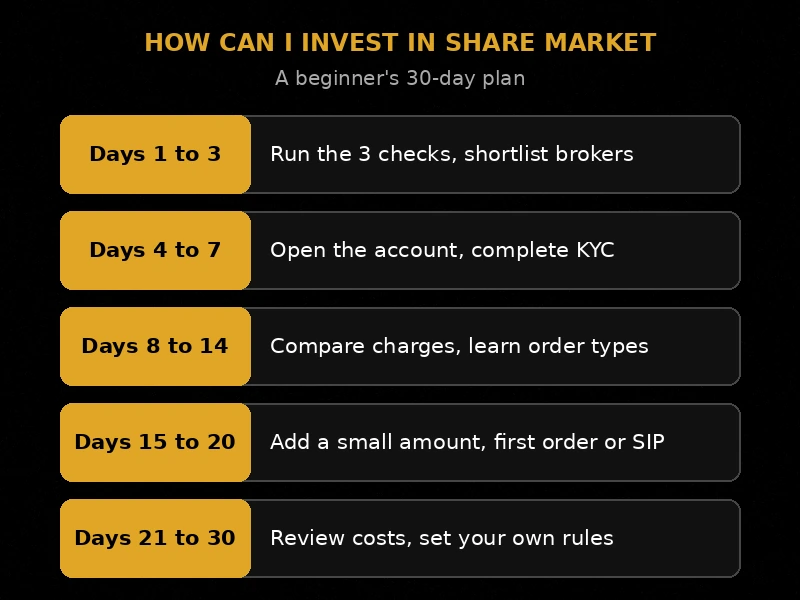
Days 1 to 3: run the three checks and shortlist two or three registered brokers.
-
Days 4 to 7: open your demat and trading account and complete KYC.
-
Days 8 to 14: compare the rate cards, then practise reading the order window without placing orders.
-
Days 15 to 20: add a small amount you can leave alone, then place your first delivery order or start a small SIP.
-
Days 21 to 30: review your contract note and holdings, work out your real costs, and write down the rules you will follow.
Frequently asked questions
What is the minimum amount I need to start?
You can buy a single share, so the minimum is the price of one share plus charges. Many platforms also let you start a mutual fund SIP from ₹500.
Can I invest without a broker?
Not directly on the exchange. Orders go through a trading account with a SEBI-registered broker, while a demat account can be opened with a depository participant such as a bank or broker.
Is the share market safe?
Registered intermediaries and exchange rules protect you from fraud, but they do not protect you from price falls. Share prices can go down as well as up, and returns are never guaranteed.
How soon do shares reach my demat account?
Under the T+1 cycle, shares you buy appear by the next working day.
How much return can I expect?
Nobody can promise a figure. Returns depend on the company, the market and how long you stay invested, and past performance does not guarantee future results.
Final word
Investing starts with preparation, not with the buy button. Run the three checks, verify your broker, know your real costs, and keep a small first trade so that you learn without risking money you cannot afford to lose.
Before you start
Go through the three checks and the 30-day plan before you open an account. For more plain-language money guides, browse the Finance section of The Vishal Media. If you spot a rate or rule that has changed, tell us and we will fix it.
Disclaimer
This article is for education only and is not investment, tax or legal advice. We do not recommend any security, fund or broker. Charges, tax rates and rules can change, and investments in the securities market are subject to market risk. Confirm current details with your broker, the exchange or a qualified professional before you invest. Read our full disclaimer.