


The number Google shows for Oman currency in Indian rupees is rarely the number you receive in your hand. That gap is the real story, and it is the part most converter pages skip. This guide from The Vishal Media gives you today’s rate, explains why the rial is worth so much, and shows what travellers, workers in Oman and returning residents really pay.
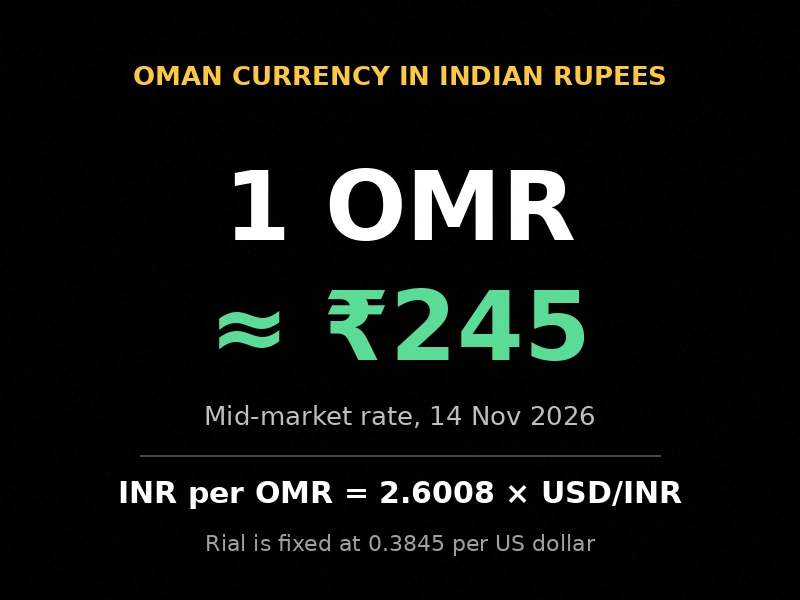
What is 1 OMR in INR today?
The table below uses the mid-market rate, which is the midpoint between buying and selling prices on global currency markets. No bank or exchange house gives you exactly this rate, but it is the fairest yardstick to judge any quote against.
| Omani rial (OMR) | Indian rupees (INR) |
|---|---|
| 1 OMR | ₹244.89 |
| 5 OMR | ₹1,224.45 |
| 10 OMR | ₹2,448.91 |
| 50 OMR | ₹12,244.50 |
| 100 OMR | ₹24,489.10 |
| 500 OMR | ₹1,22,445 |
| 1,000 OMR | ₹2,44,891 |
Going the other way, 1 INR is about 0.0041 OMR, so ₹1,000 buys roughly 4.08 OMR and ₹10,000 buys roughly 40.83 OMR.
Source: XE mid-market rate of ₹244.89 (last update 13 November 2026, 16:39 UTC), cross-checked with BookMyForex’s interbank rate of ₹245.35 on 14 November 2026. Currency markets are closed on weekends, so a Saturday figure is the latest Friday rate. Rates change on trading days, so treat these numbers as a snapshot and refresh them before you act.
Why one Omani rial is worth so much
A single rial buys more than two and a half US dollars. That is not a sign of a giant economy. It is a pricing choice. The Central Bank of Oman holds the rial at a fixed rate against the dollar, and the bank has said the rate is not something it sets freely, because the peg ties Oman’s interest rates closely to US policy. The level has been 2.6008 USD per rial since 1986, when it was reset from 2.895. Recent data through July 2026 still shows 0.3845 OMR per dollar.
For you, this has one simple consequence. The rial does not wobble against the rupee on its own. When the OMR to INR rate changes, the dollar-rupee rate has changed.
Here is the formula in one line:
INR per OMR = 2.6008 × USD/INR
Working backwards from the latest rate, the dollar is trading near ₹94.2, and 2.6008 × 94.16 gives about ₹244.89. A quick mental shortcut for travellers is to multiply any rial price by 2.6 to see the dollar cost, then multiply by the current dollar rate.
The rate you see vs the rate you get
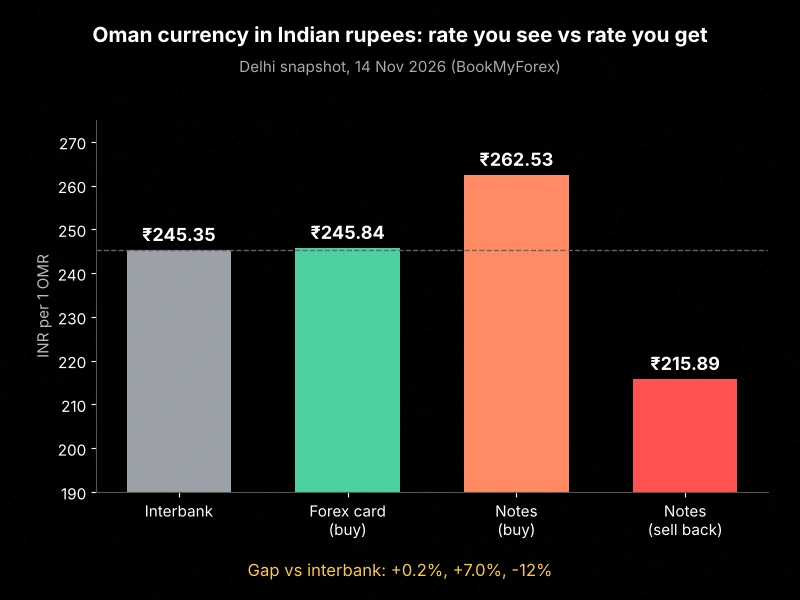
This is where real money is won or lost. Take one provider’s Delhi snapshot from 14 November 2026 and compare each rate with the interbank rate of ₹245.35.
| Way of converting | Rate per 1 OMR | Gap vs interbank |
|---|---|---|
| Interbank (reference) | ₹245.35 | Baseline |
| Buying on a forex card | ₹245.84 | About 0.2% higher |
| Buying currency notes | ₹262.53 | About 7% higher |
| Selling currency notes back | ₹215.89 | About 12% lower |
The pattern is simple. You pay more than the reference rate when you buy rial, and you receive less when you sell it. Cash is the most expensive way to do both. A forex card sits almost on top of the interbank rate in this sample.
Treat these figures as one provider’s snapshot, not a universal price list. Rates differ by city, provider, amount and time of day, so always ask for the final rupee amount before you confirm.
What this looks like with real amounts
A traveller buying 200 OMR for a Muscat trip. At the interbank rate, 200 OMR is ₹49,070. On a forex card it is ₹49,168. As notes, it is ₹52,506, which is ₹3,436 more than the reference for the same money.
A worker sending 300 OMR home every month. At the mid-market rate, 300 OMR is about ₹73,467. If your channel’s effective rate is just 1% weaker, your family receives about ₹735 less each month, or roughly ₹8,816 over a year. The 1% is an illustration, because actual margins vary by channel.
Someone back in India with 40 leftover rial notes. At the interbank rate, 40 OMR is worth ₹9,814. Selling the notes at the ₹215.89 rate above returns ₹8,636, a loss of about ₹1,178. If that balance is on a forex card instead, it can usually be kept for a future trip, so check your card’s terms before selling anything.
Going from India to Oman: the rules to know
The Reserve Bank of India sets the ground rules for buying foreign currency for travel. In its FAQ on forex facilities, the RBI says travellers to most countries can buy foreign currency notes or coins only up to USD 3,000 per visit, and the rest has to travel as a card, travellers cheque or draft. The same FAQ says cash payment for forex is allowed only below ₹50,000, while anything at ₹50,000 or above must be paid by cheque, draft, pay order, debit card, credit card or prepaid card.
Two practical points follow from that. A forex card or an international debit card is usually easier than carrying a large amount of cash. And every forex purchase counts toward your annual Liberalised Remittance Scheme limit.
On tax, TCS (tax collected at source) applies to outward remittances under that scheme. For most purposes it kicks in only after ₹10 lakh of such remittances in a financial year, but rates and treatment have changed in recent Union Budgets and differ by purpose, and overseas tour packages follow separate rules. Most trip budgets stay far below the threshold. Ask your bank for the current rate on your exact transaction before you pay.
Back from Oman with leftover rial
The RBI says a returning traveller should surrender unspent foreign currency notes and travellers cheques to an authorised dealer within 180 days of coming back. You may keep notes and travellers cheques up to USD 2,000 in total for future trips, and foreign coins can be held without a limit. Even if you miss the 180-day window, the RBI circular says an authorised dealer should not refuse to buy your foreign exchange on that ground alone.
If you bring a large amount into India, declare it. The Currency Declaration Form applies when notes, bank notes and travellers cheques together exceed USD 10,000, or when foreign currency alone exceeds USD 5,000, or the equivalent.
Selling rial back for rupees is an inward conversion, so the outward-remittance TCS described above is not the relevant rule, but confirm with your bank at the counter.
Sending money from Oman to India
This is the corridor where small differences compound every month, so compare channels the same way every time. Ask each option for three things in writing: the exchange rate, the fee, and the exact rupee amount that will reach the account.
Then calculate the effective rate:
Effective rate = rupees received ÷ rial paid (fee included)
Compare that number with the mid-market rate at the top of this article. The smaller the gap, the better the deal. Rates can change between the quote and the moment of transfer, so confirm the final amount on the confirmation screen.
One more safeguard is accuracy of the receiving details. A wrong account number or IFSC code can delay or fail a transfer. If the money is going to an Airtel Payments Bank account, our guide to the Airtel Payment Bank IFSC code walks through how to send and receive money without errors.
How the rate moved over the last 30 days
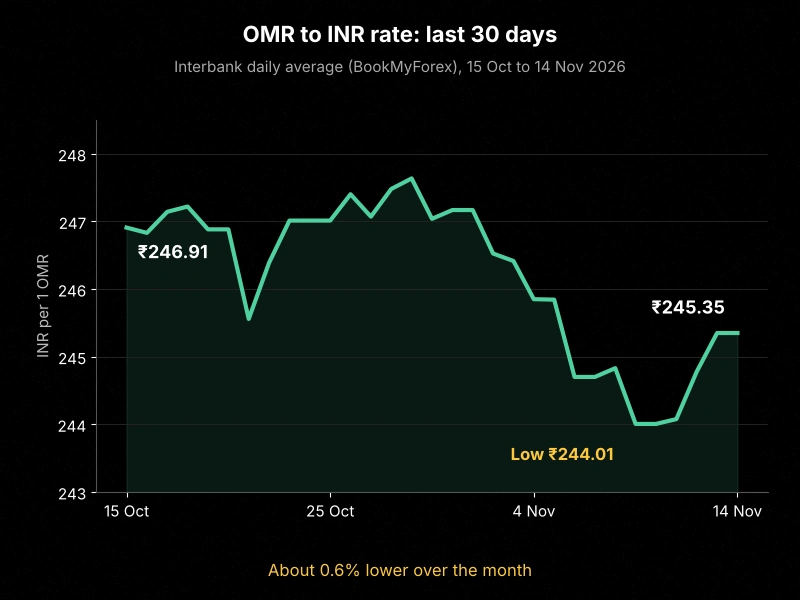
BookMyForex’s daily history shows the interbank rate sliding from about ₹246.91 on 15 October to a low of about ₹244.01 on 9 and 10 November 2026, then recovering to about ₹245.35 by 13 and 14 November. Over the full month that is a net drop of roughly 0.6%. XE’s data puts the 90-day range between ₹243.52 and ₹251.49, with a 90-day average of ₹247.81, so the rate still sits near the lower end of that window.
What does that mean in practice? Because the rial is tied to the dollar, a falling figure means a stronger rupee against the dollar and a rising one means a weaker rupee. Anyone converting rial into rupees got fewer rupees per rial in early November than in mid-October, while anyone buying rial for a trip paid fewer rupees. Nobody can reliably predict where it goes next, so avoid waiting for a perfect rate if you have a bill or a flight to pay.
Check the rate yourself in 60 seconds
-
Look up the current US dollar to Indian rupee rate from a source that shows its timestamp.
-
Multiply that number by 2.6008.
-
Compare the result with the rate on your quote or card statement.
If your rate is far below that figure when you sell, or far above it when you buy, ask the provider why before you proceed.
Frequently asked questions
How many rupees do I get for one Omani rial?
Around ₹245 at the mid-market level on 14 November 2026. Your own rate will be higher or lower depending on whether you buy or sell and through which channel.
How much is one rupee in Omani rial?
About 0.0041 OMR. Put differently, ₹1,000 is roughly 4.08 OMR.
What is a baisa?
It is the smaller unit of the Omani currency. One rial is made of 1,000 baisa, so prices in Oman are often shown with three decimal places.
Can the rial’s value against the rupee change suddenly?
Yes, but the trigger is almost always the dollar-rupee rate, not Oman. The Central Bank of Oman has repeatedly said it is committed to the dollar peg, though no fixed rate is guaranteed forever.
Do I have to sell my leftover rial?
Notes and travellers cheques must be surrendered within 180 days of return, except for up to USD 2,000 in total that you may keep. Check your card’s terms if the balance is on a forex card.
Final word
The headline rate is only the starting line. The real cost of the OMR to INR conversion depends on whether you use cash, a card or a transfer, and on whether you are buying or selling. Check the mid-market rate, work out your effective rate, and keep the RBI rules in mind.
Before you convert
Run the 60-second check above before you buy rial, send money from Oman or sell leftover notes. For more plain-language money guides, browse the Finance section of The Vishal Media. If you spot a rate that has moved or a detail that needs updating, tell us and we will fix it.
Disclaimer
This article is for general information only and is not financial, tax or legal advice. Exchange rates change throughout the day, rate examples are indicative snapshots, and rules on forex and TCS can change. Confirm the current rate and rules with your bank or an authorised dealer before you transact. Read our full disclaimer.